Choosing an AI development partner can directly affect the quality, scalability, security, and long-term cost of an AI product. With more companies offering artificial intelligence development services, comparing providers only by price or a list of technologies is rarely enough.
If you are researching how to choose AI development company options, start by looking at technical expertise, relevant experience, development practices, communication, security, and post-launch support. The right partner should understand your business problem and translate it into a practical AI solution rather than simply adding AI to your software.
Here is a 12-point checklist to help you evaluate potential AI development companies:
1. Check Their AI Development Experience
Start by reviewing the company's experience with AI projects similar to yours. Look beyond the number of years in business and examine the types of AI solutions it has actually delivered.
Depending on your requirements, this could include:
Generative AI applications
Machine learning solutions
AI chatbots
Natural language processing
Computer vision
Predictive analytics
AI agents
AI-powered automation
AI integration
Relevant experience can help a development team understand common technical challenges before they become expensive problems.
2. Review Relevant Case Studies
Case studies can provide more useful information than generic claims about AI expertise.
Look for examples that explain the client's problem, the solution developed, technologies used, and measurable results. If a company only shows screenshots without explaining the development challenge or outcome, ask for more detail.
Ideally, the projects should demonstrate experience with business requirements similar to yours, even if they are from a different industry.
3. Evaluate Their AI Technology Expertise
The right AI development company should understand more than one AI technology.
Ask potential partners about their experience with technologies relevant to your project, such as:
Large language models
Machine learning frameworks
Generative AI
Retrieval-augmented generation
Natural language processing
Computer vision
Recommendation systems
AI agents
Cloud AI services
APIs and third-party AI platforms
You do not necessarily need every technology. What matters is whether the company can select the appropriate technology for your particular use case.
4. Ask How They Approach Your Business Problem
A strong AI partner should ask questions before recommending a solution.
During early discussions, they should try to understand:
What problem are you trying to solve?
Who will use the application?
What data is available?
Which systems need integration?
What business outcome should AI improve?
How will success be measured?
Be cautious if a company immediately recommends a specific model or technology without first understanding your requirements.
5. Check Their Data Expertise
AI applications depend heavily on data. Your development partner should understand how data will be collected, cleaned, stored, processed, accessed, and evaluated.
Ask how the company handles:
Data preparation
Data quality
Data pipelines
Model training data
Data retrieval
Access permissions
Data privacy
Data storage
This becomes particularly important when the AI application uses confidential business information or customer data.
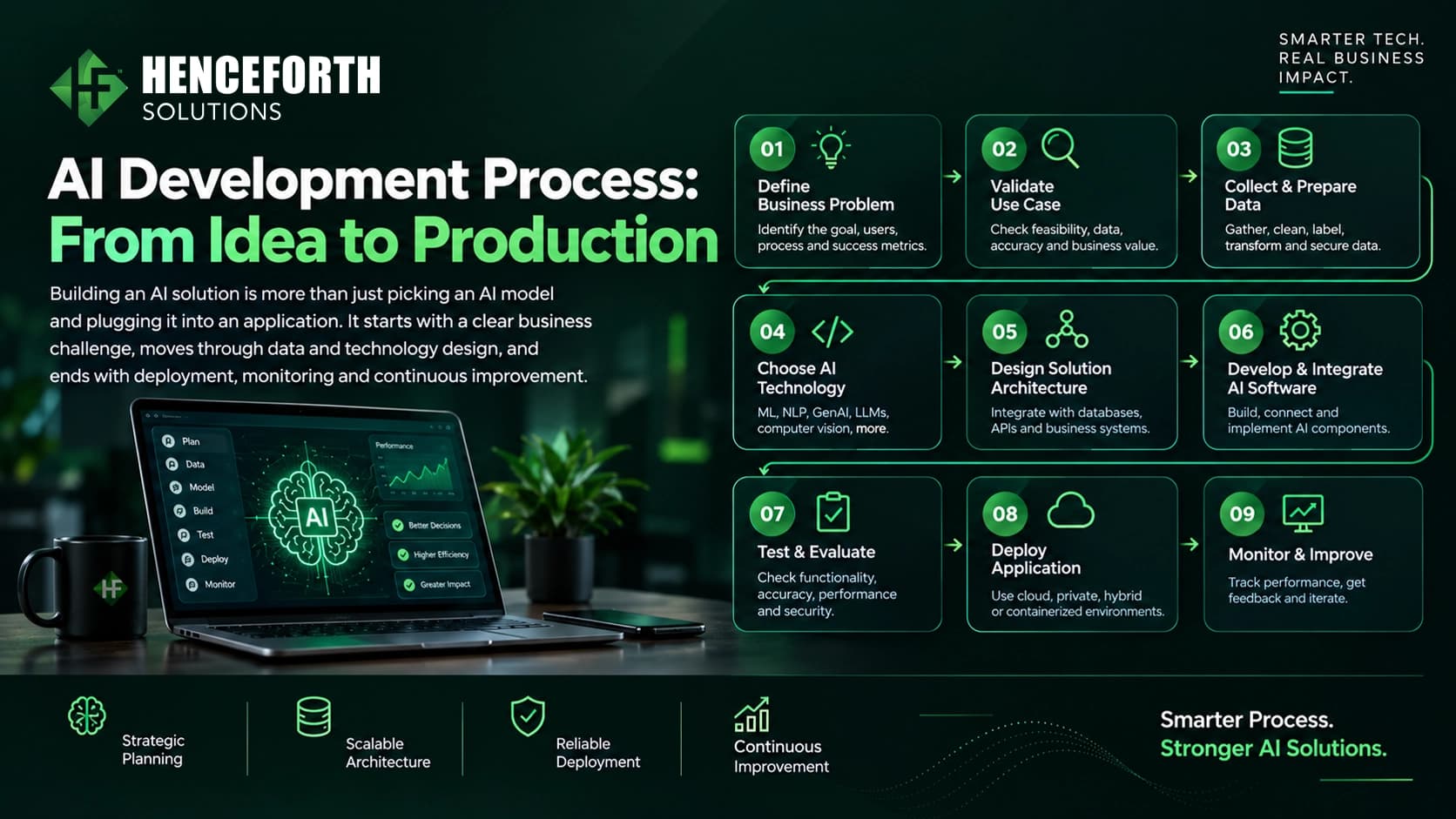
6. Understand Their Development Process
Ask the company to explain its AI development process from discovery through production.
A structured approach may include:
Business and technical discovery
Use-case validation
Data assessment
Architecture planning
AI model selection
Development and integration
Testing and evaluation
Deployment
Monitoring and improvements
The exact process will vary by project, but you should understand what happens at each stage and what deliverables you will receive.
7. Evaluate Their Integration Capabilities
AI rarely works in isolation. Your application may need to connect with CRM systems, ERP platforms, databases, payment systems, analytics tools, internal applications, or APIs.
Ask potential development partners about their experience integrating AI with existing software.
This is especially important if you are adding AI to an established product rather than building a new application from scratch.
A technically strong AI model will have limited business value if it cannot work reliably within your existing workflow.
8. Ask About Security and Responsible AI
Security should be part of the development discussion from the beginning.
Ask how the company plans to handle:
Sensitive business data
Authentication and authorization
Data encryption
API security
Access controls
AI output monitoring
Model evaluation
Logging and auditing
Compliance requirements
You should also understand where your data is processed and which third-party AI services are involved.
A reliable partner should be able to explain the security architecture in business-friendly terms rather than simply saying that the application is "secure.
9. Check Scalability and Architecture
An AI application that works for 100 users may require a different architecture when it reaches 100,000 users.
Ask how the proposed solution will handle increasing:
Users
AI requests
Data volumes
API calls
Processing requirements
Infrastructure demands
The development company should be able to explain how the architecture can evolve as your product grows.
Scalability should be considered during architecture planning rather than added after performance problems appear.
10. Understand Pricing and Ownership
Price is an important factor, but it should not be the only selection criteria.
Ask for clarity around:
Development costs
AI model/API usage
Cloud infrastructure
Third-party services
Maintenance
Support
Future enhancements
Licensing
Source-code ownership
Intellectual property rights
This helps prevent unexpected costs after launch.
A lower initial quote may not be the cheaper option if it excludes important development, infrastructure, or maintenance requirements.
11. Evaluate Communication and Project Management
AI projects involve technical decisions that may change as the team learns more about the data and use case. Clear communication is therefore important.
Before signing a contract, understand:
Who will manage the project?
How often will you receive updates?
Who handles technical decisions?
How will changes be documented?
Which communication channels will be used?
How will issues and delays be reported?
You should also know who will be responsible for product, AI, development, testing, and deployment decisions.
12. Check Post-Launch AI Support
AI development does not necessarily end when the application goes live. Models, APIs, data, infrastructure, and user requirements can change over time.
Ask whether the company provides support for:
Performance monitoring
Bug fixes
Model updates
AI evaluation
Infrastructure scaling
Security updates
Feature improvements
Technical maintenance
A post-launch support plan can be particularly important for business-critical AI applications.
Questions to Ask an AI Development Company
Before selecting a partner, ask direct questions rather than relying only on a company's website.
Some useful questions include:
Have you built a solution similar to ours?
Which AI approach would you recommend and why?
What data will the application require?
Which AI models or APIs will you use?
How will you evaluate AI performance?
How will the solution integrate with our existing systems?
How will our data be protected?
Who owns the source code and intellectual property?
What will the ongoing AI and infrastructure costs include?
What support will be available after launch?
The quality of the answers can tell you a lot about how the company approaches AI development.
Common Mistakes When Choosing an AI Development Company
Businesses sometimes select an AI partner based on the wrong criteria. Common mistakes include choosing the lowest quote, focusing only on technology names, ignoring data requirements, or failing to discuss ownership and maintenance.
Another mistake is selecting a company that can build a demonstration but has limited experience taking AI applications into production.
A successful AI product needs more than a working prototype. It needs reliable software engineering, appropriate AI evaluation, security, integrations, scalability, and ongoing support.
How to Choose the Right AI Development Company
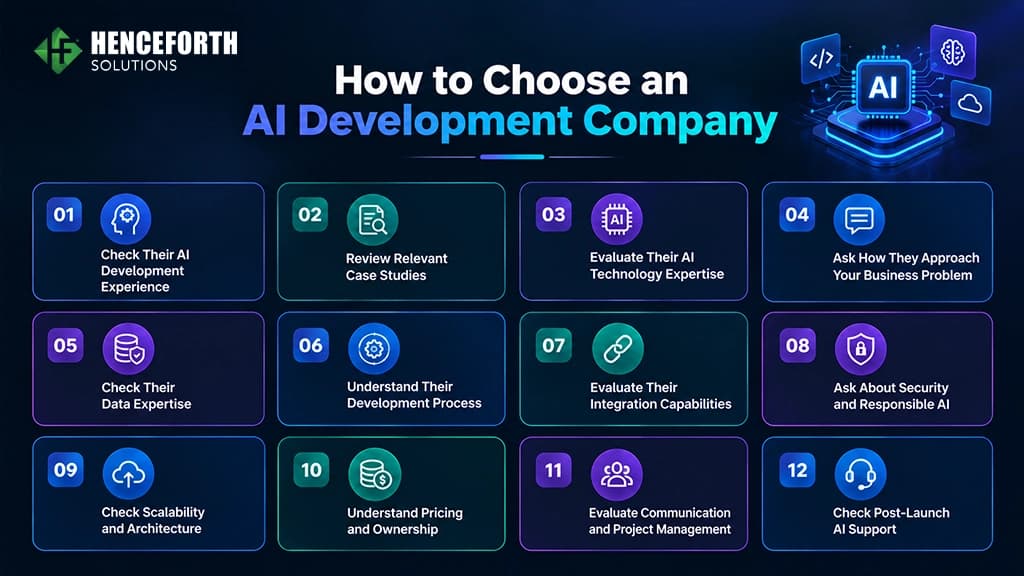
The best way to decide how to choose AI development company options is to compare potential partners against the same requirements.
Create a shortlist and evaluate each company on:
Evaluation area | What to check |
AI expertise | Relevant technologies and capabilities |
Experience | Similar projects and case studies |
Data | Data preparation and handling |
Architecture | Scalability and integrations |
Security | Protection, access, and compliance |
Process | Development and testing approach |
Communication | Project management and reporting |
Ownership | Source code and IP terms |
Pricing | Development and ongoing costs |
Support | Post-launch maintenance |
This makes the decision more objective and helps identify gaps before development begins.
Conclusion
Knowing how to choose AI development company partners requires looking beyond portfolios and hourly rates. The right partner should understand your business problem, recommend suitable AI technology, work effectively with your data, build a scalable architecture, and provide support after launch.
Evaluate experience, technical capabilities, security practices, communication, ownership, pricing, and long-term support before making the final decision. A development partner that combines AI expertise with strong software engineering can help turn an AI concept into a reliable business product.