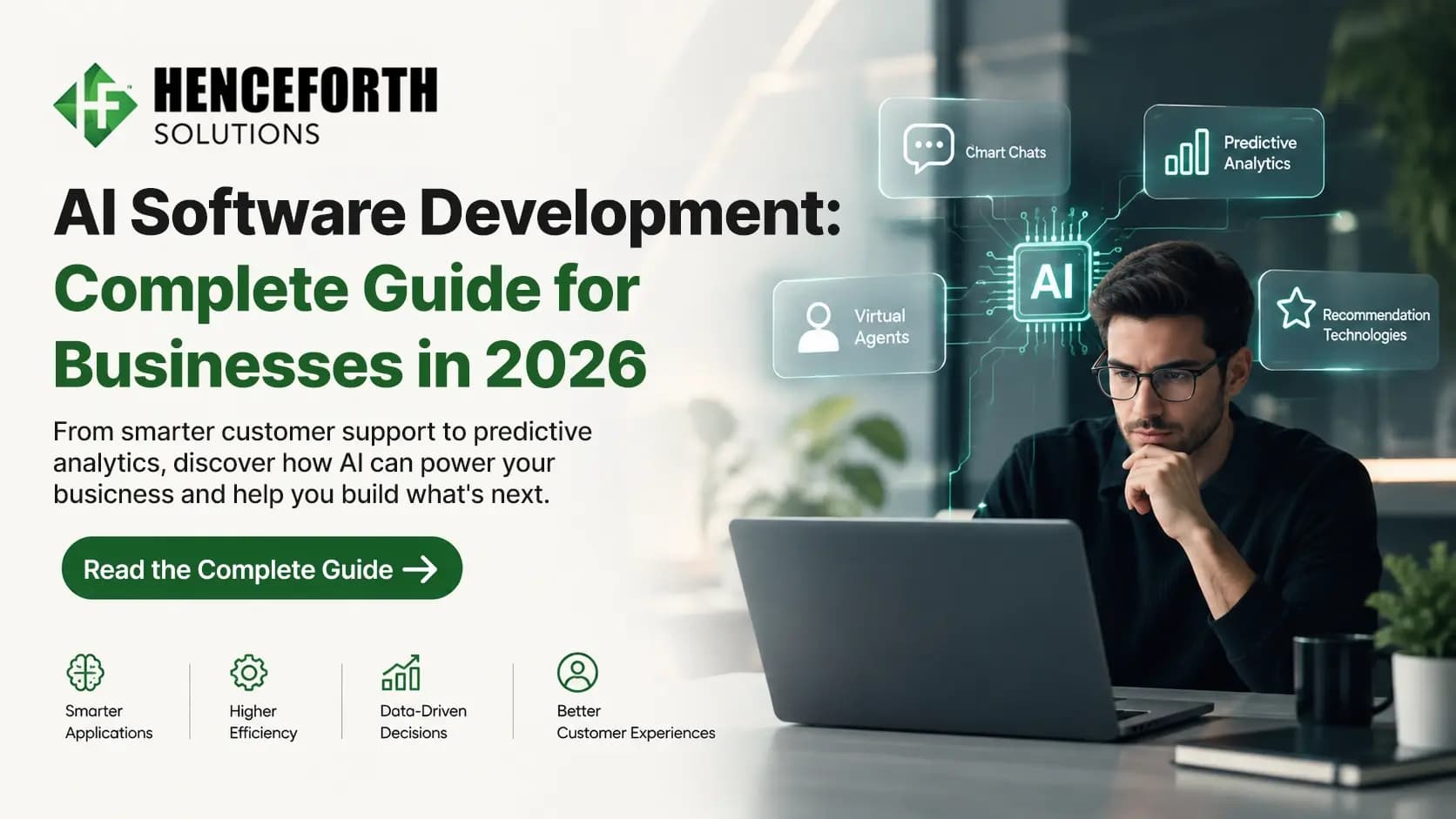
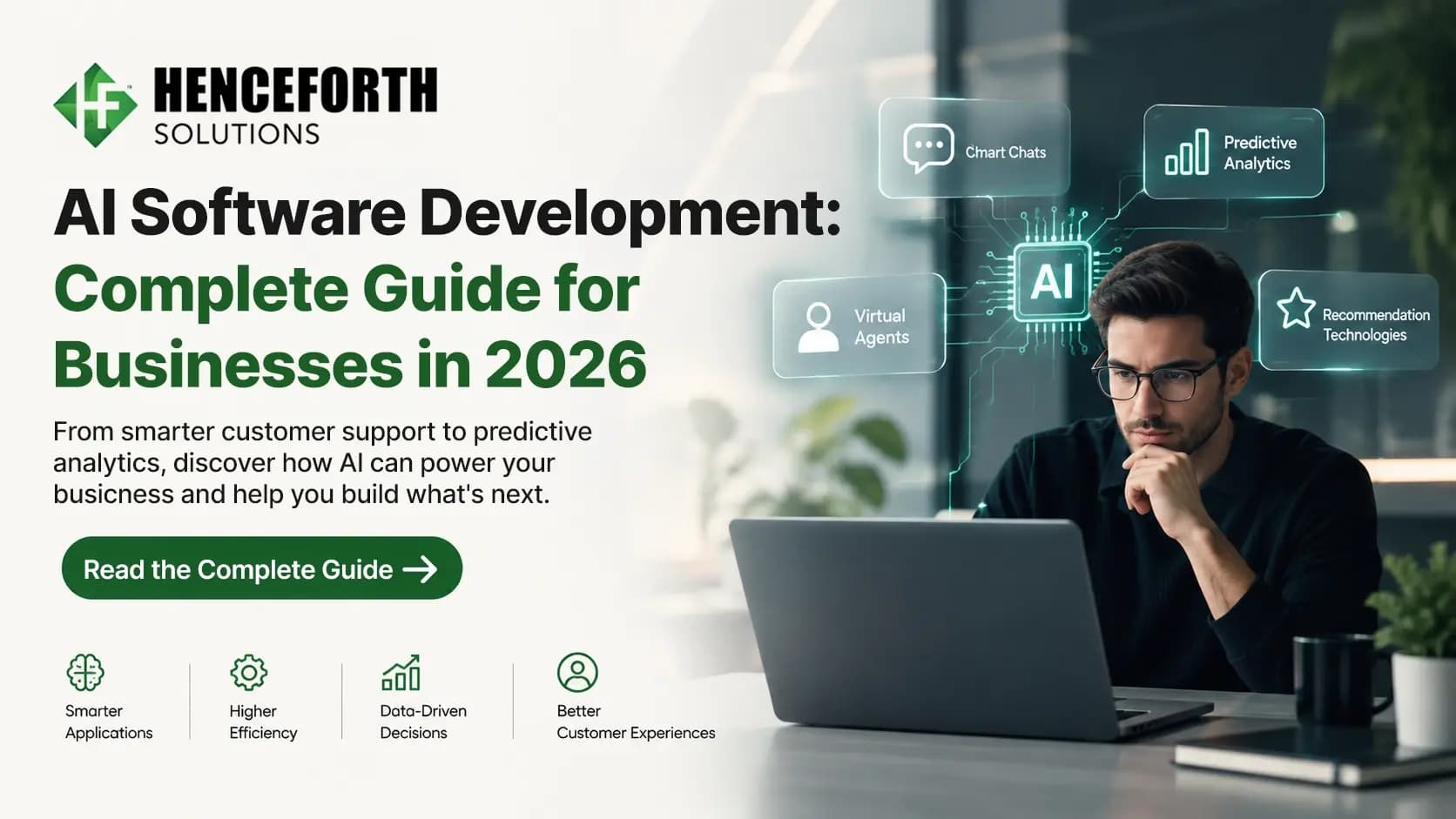
AI is becoming part of everyday business software, from customer support and analytics to automation and decision-making. OECD data shows that 20.2% of firms reported using AI in 2025, up from 14.2% in 2024 and 8.7% in 2023. AI software development facilitates the merging of AI models with trade applications, information, workflows, and other systems.
AI can offer businesses such applications as smart chats, recommendation technologies, predictive analytics, and virtual agents for meeting their user needs and now companies have the opportunity to create their applications as needed. The choice of the most suitable way to implement AI in a particular business depends on the exact problem to solve, available data, type of users, security requirements, and goals.
What Is AI Software Development?
AI software development is the activity of creating software that utilizes artificial intelligence to complete tasks involving reasoning, pattern identification, understanding language, forecasting, or offering decision-making assistance.
AI-based software is different from conventional software in that the former can deal with data, identify patterns, generate outcomes, make forecasts, and improve its ability depending on certain training or feedback.
The use of artificial intelligence by educational institutions is beneficial in many ways, including but not limited to:
Automation of mundane tasks
Analysis of data about the clients and operations
Provision of personalized recommendations
Detection of frauds or anomalies
Prediction of demand and trends
Developing of intelligent bots and other virtual assistants
Creation of text, graphics, code, or any other kind of content
Assisting of the staff in their work with AI-based tools
Development of artificial intelligence-based systems that execute specific tasks
Henceforth Solutions provides AI solutions in fields such as machine learning, natural language processing, predictive analysis, generative AI, AI modules, and computer vision.
Why Are Businesses Investing in AI Software?
AI adoption is no longer limited to technology companies. The OECD reported that 57.3% of ICT firms used AI in 2025, while professional and scientific services reached 36.8%.
An example of the application of AI in e-commerce is recommendation engines for enhanced product discovery. Financial organizations may apply AI to combat fraud and analyze risks, while healthcare service providers can leverage the power of AI for data analysis as well as to improve administrative processes.
The key advantages of applying AI are:
Increased efficiency: AI technologies are capable of performing monotonous tasks, which helps to reduce the extent of hard work executing the same operation.
Speedy solutions: with the help of AI, one can analyze enormous volumes of information and see trends much quicker than with the help of standard analytics.
Improved customer experience: AI technologies enhance interaction with users making it more personalized thanks to intelligent agents.
Automation of business processes: applying the power of AI in business operations gives it an opportunity to connect to other processes and procedures in order to act based on a set of pre-defined criteria.
Scaling: properly developed AI technologies can increase the number of dealt operations handled, clients, and data.
Types of AI Software Businesses Can Build
AI applications are not one of a kind. The proper solution relies on what the firm wants to automate, forecast, understand or generate.
Generative AI applications can create outputs like text, graphics, code, summaries, etc. Businesses can utilize them for content pipelines, internal knowledge tools, customer support and productivity apps.
AI Chatbots & Virtual Assistants
AI chatbots understand what the user is asking and deliver contextual answers. Connected to business systems, they can also help users execute activities like reviewing information, booking appointments, or discovering pertinent data.
Applications of Machine Learning
Machine learning software applies patterns to historical and real-time data for use in predictions or classifications. Typical uses include demand forecasting, fraud detection, consumer segmentation, and recommendation systems.
AI Agents (Artificial Intelligence Agents)
AI agents are designed to perform certain activities or workflows with a higher degree of autonomy. Depending on the use case an agent can fetch information, connect with business systems, conduct activities and report outcomes.
Computer Vision Solutions
Computer vision is the ability for software to comprehend images and video. Businesses can use it for inspection, document processing, identification verification, object detection and other visual operations.
Key Components of AI Software Development
An AI model alone is not enough to build a reliable AI application. The end product is the result of combining a number of technical pieces.
Data Layer: Data collection, data cleansing, structuring and storage of data for use by the AI system.
AI Models: Machine learning, generative AI, NLP, computer vision or other AI models perform the tasks which require intelligence.
Application Layer: Model is embedded in the web app, mobile app, dashboard or any other internal software that the consumers interact with.
APIs & Integrations: APIs help in connecting AI capabilities to CRM, ERP, payments, analytics, cloud and other business platforms.
Infrastructure: Cloud or on-premises infrastructure that helps in deploying and scaling the models.
Security & Governance: Access control, data security, monitoring and testing will help organizations to manage risks around AI.
These components are tied together around a well-defined business aim by a solid architecture.
How to Plan an AI Software Project
Before starting any development work, organizations should figure out where AI can add value in practice. Focusing on the technology rather than the problem leads to overengineering and poor adoption.
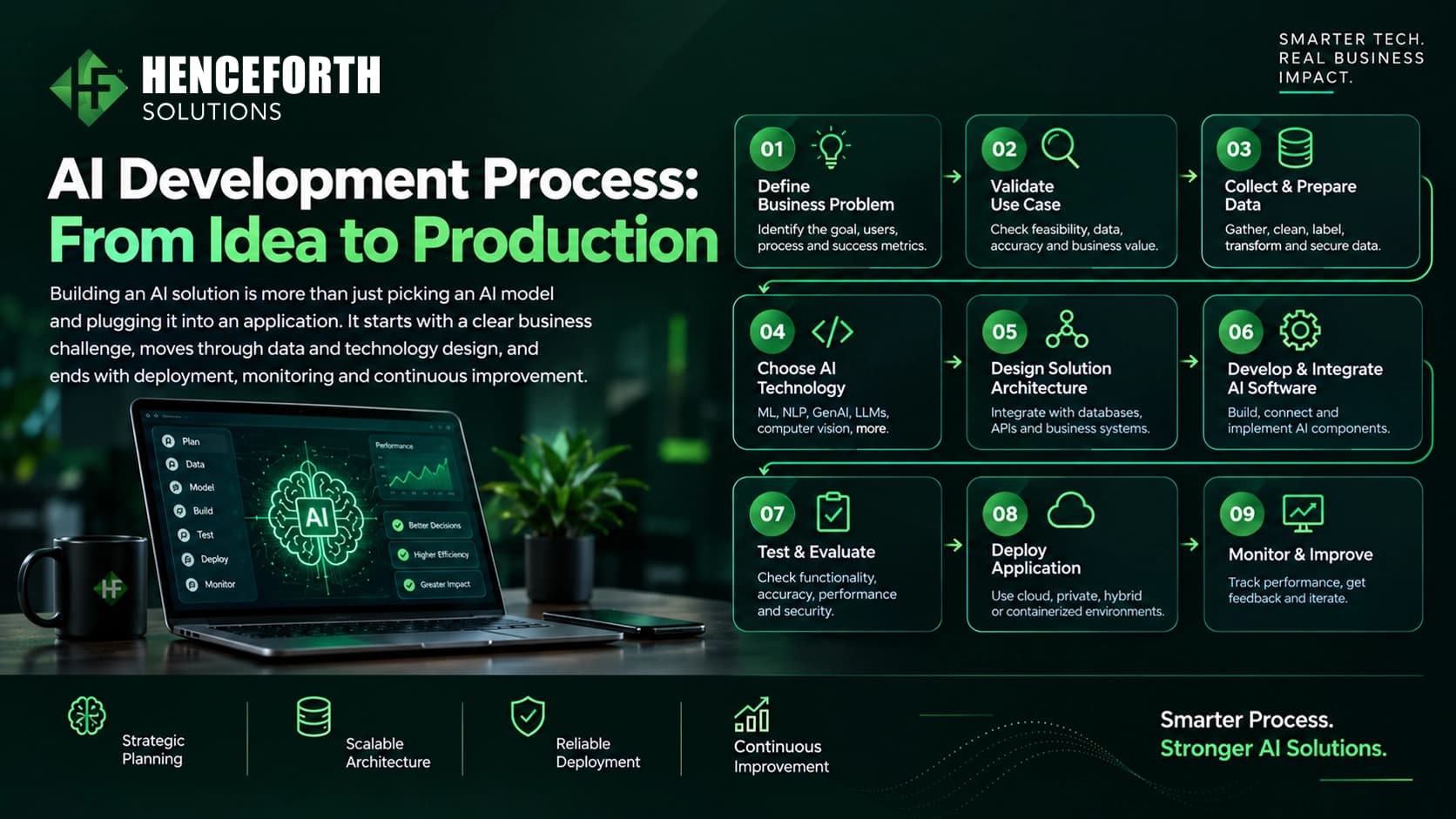
Effective planning framework looks as follows:
Problem definition: Identify the process, customer need or decision to be improved.
Identify the AI use case: Choose one of the use cases like prediction, automation, generation, classification, etc.
Data evaluation: Evaluate data quality, availability, structure, ownership and privacy aspects.
Select the technology stack: Pick models, frameworks, APIs, databases, infrastructure, etc.
Development and validation: Build the solution and validate its accuracy, reliability, usability and performance.
Deployment and monitoring: Deploy the application and monitor performance, cost, security and feedback.
AI development process can differ widely depending on the complexity of the project, which is the reason for proper discovery and planning beforehand.
AI Software Development Tech Stack
The technology stack depends on the application's requirements and the type of AI being implemented. A typical stack may include:
Layer | Common Technologies |
Programming | Python, JavaScript, TypeScript, Java |
AI/ML | TensorFlow, PyTorch, Scikit-learn |
Generative AI | Large language models, embeddings, vector databases |
Backend | Node.js, Python frameworks, Java |
Databases | PostgreSQL, MySQL, MongoDB |
Cloud | AWS, Microsoft Azure, Google Cloud |
APIs | REST APIs, AI model APIs, third-party integrations |
Infrastructure | Docker, Kubernetes, CI/CD tools |
The final selection should be based on performance, scalability, security, development requirements, and the existing technology environment rather than following a fixed stack.
What Does AI Software Development Cost?
The cost of AI software development varies from project to project. A basic AI-powered feature and a large enterprise platform have very different requirements.
Some of the factors that determine the cost are as follows:
Complexity of the AI capabilities
Data preparation and data availability
Development or API integration
Integration counts
Applications and platform features
Security and compliance considerations
Infrastructural needs and cloud considerations
Testing and support
In this case, companies need to assess AI projects on the basis of value and cost instead of the generic software development price tag.
How Businesses Can Get Started With AI
The first step is identifying a concrete business problem whose outcome can be measured. The organization doesn’t have to create an extensive artificial intelligence infrastructure at once. It has to start with a specific case, test its results, and then evolve the solution based on the requirements.
Data readiness, user adoption, security, integration considerations, and model performance during the life cycle of the application are all important factors that must be considered before development starts.
Henceforth Solutions works with enterprises on AI consulting, custom AI development, generative AI, AI agents, machine learning, AI integration, and automation. At the moment, its AI solution is oriented towards creating and scaling AI solutions based on business needs.
Conclusion
AI software development can help businesses move from manual processes and disconnected data toward intelligent, automated, and more responsive software. Whether the goal is better customer support, predictive analytics, workflow automation, content generation, or intelligent decision support, the technology should be selected around the business objective.
Starting with an adequate use case, quality data, appropriate technology, and scalable architecture are the keys, and then the successful implementation could serve as the basis for further development of AI across the entire company.