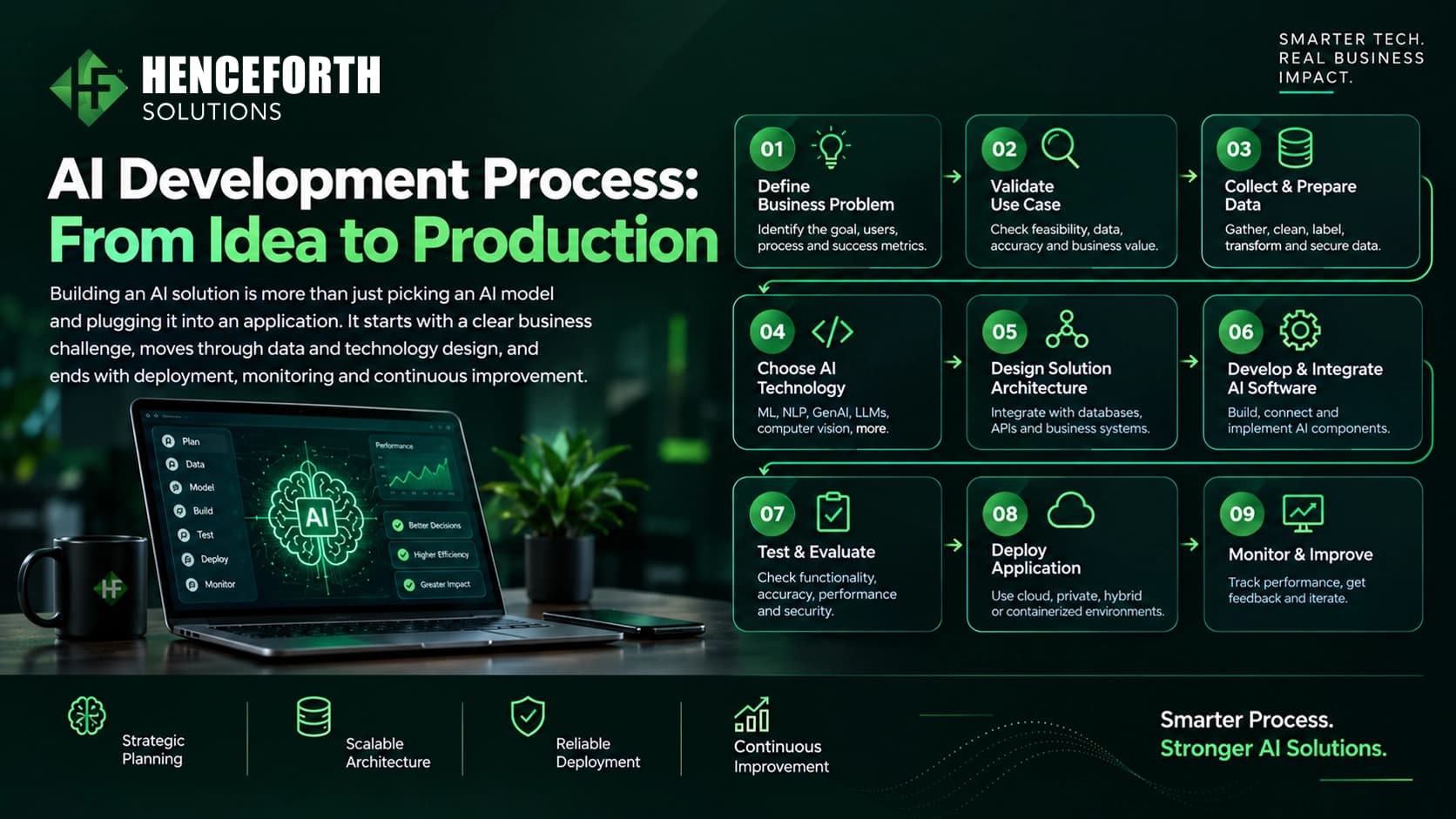
Building an AI solution is more than simply picking an AI model and plugging it into an application. A good AI development process starts with a clear business challenge, moves through designing the data and technology, and finishes with deployment, monitoring, and continuous improvement.
For organizations, a disciplined methodology reduces technological uncertainty and ensures AI is built around a realistic use case. The steps need to be connected to the next, whether the goal is to construct an AI chatbot, a predictive analytics platform, a recommendation engine, a generative AI application or an AI agent.
What Is the AI Development Process?
AI development process is an organized path from an AI idea to a workable software solution. Starting with the business challenge and data evaluation, and ending with the application, testing the solution, and deploying it for real users, it encompasses everything.
A common process would be to:
Defining business problem
Validate the AI use case
Data collection and preparation
Selecting the artificial intelligence technology
Design of solution architecture
Creating and integrating the AI
Solution testing and evaluation
Application Deployment
Monitoring the system and upgrading it
The specific phases may differ based on the nature, size and complexity of the AI project.
Step 1 : Define the Business Problem
The initial phase of AI development is to figure out what problem the software needs to address.
Businesses should specify the end goal, rather than start with a technology such as machine learning or generative AI. For example, the purpose could be to decrease customer care workload, estimate demand for products, automate document processing, identify anomalous transactions or improve search.
Having a precise problem statement helps to decide if AI is right and which AI capability to apply.
At this point, businesses should identify:
The problem we're looking at
The final user
Existing process
Expected business result
Resources available
Metrics of Success
This provides the development team with a working basis for the project.
Step 2 : Validate the AI Use Case
Not every business problem requires AI. The next stage is determining whether an AI solution can realistically improve the existing process.
The team can assess factors such as data availability, technical feasibility, expected accuracy, integration requirements, and potential business value.
For example, a rule-based workflow may be sufficient when the process is simple and predictable. AI may be more suitable when the software needs to identify patterns, understand natural language, make predictions, or generate content.
This stage can prevent businesses from investing in AI where a simpler solution would work better.
Step 3 : Collect and Prepare Data
Data is an essential part of many AI applications. The development team must know which data is available, where it originates from and if it is suitable for the intended use case.
Data preparation can involve, depending on the project:
Data Gathering
Data cleaning
Labeling data
Transformation of data
Data verification
Data storage
Data access control
AI system requirements differ. A generative AI application might use a pre-trained model, business documents, and retrieval systems, while a predictive machine learning application may need historical datasets for model training and evaluation.
Data assessment is an important part of planning, as poor-quality or incomplete data can affect the usefulness of an AI system.
Step 4 : Choose the AI Technology
Having established the use case and the data requirements for the system, the team would be able to pick the appropriate artificial intelligence (AI) technology that would fit the use case.
This could include one of the following technologies:
Machine learning
Natural language processing
Generative Artificial Intelligence
Massive language models
Computer vision
Recommendation systems
Predictive analytics
In addition, the team would have to determine whether they would use an existing AI model, modify an existing AI model or create a new model altogether.
Step 5 : Design the AI Solution Architecture
The next step involves defining the implementation of the AI capability into the whole software.
AI usually doesn’t stand alone. It might be necessary to integrate it with databases, APIs, cloud infrastructure, business systems, authentication mechanisms, and user interfaces.
Some common architecture can look like this:
User interface -> Application backend -> AI service/model -> Data/knowledge layer -> Business systems
In certain use cases, extra components like vector databases, APIs, monitoring systems, data pipelines, or workflow engines might be needed.
Proper architecture design makes sure that the solution remains maintainable and scalable.
Step 6 : Develop and Integrate the AI Software
This is where the design architecture becomes a working application.
Developers build the application layer, linking the chosen artificial intelligence technology to the data and business systems that are needed. Development can include model integration, prompt design, data pipelines, APIs, backend services, frontend interfaces, automation workflows, and user permissions, depending on the project.
For example, a development team creating a generative AI application may connect a language model to a company’s internal knowledge base so that users get answers based on approved business information.
The goal is to incorporate the AI capability so that it is useful in the real workflow rather than it being a standalone model.
Step 7 : Test and Evaluate the AI System
AI software testing needs to happen at the application and AI levels.
Classic software testing can verify that features, APIs, authentication, and workflows function correctly. AI evaluation also has to assess the quality and consistency of model outputs.
Testing includes:
Functional Test
Assessing model performance
Accuracy test
User Acceptance Tests
Security testing.
Performance Test
Integration testing
Testing for edge cases
Evaluation of generative AI use cases may also include factors such as relevance, accuracy, consistency, and compliance with the prompt of the response.
Testing needs to continue after deployment as artificial intelligence systems can behave differently as models, data, integrations or user behavior change.
Step 8 : Deploy the AI Application
Upon successful testing, the AI solution can be deployed for production.
This process may include cloud services, databases, APIs, application servers, models endpoints, monitoring and access controls. Deployment will vary depending on the application needs, performance demands, and data sensibilities.
Firms can consider different ways of deploying their solutions like:
Cloud deployment
Private infrastructures
Hybrid environments
Containerized deployment
AI services via APIs
A pilot launch can help organizations detect production problems before full roll-out.
Step 9 : Monitor and Improve the AI System
The development of AI doesn’t end once an application is live. Production monitoring of the system is needed to verify if it still performs as expected.
Teams can keep track of:
AI answer quality
Accuracy & Performance
Availability of the App
Latency
Use of AI models
Usage of infrastructure
User reviews
Faults and requests that failed
Measuring business performance
Monitoring can alert you to when an AI model needs tuning, when data drift is impacting performance, or when your infrastructure needs scaling.
Regular assessment also helps businesses enhance the product as user needs and artificial intelligence technologies evolve.
How Long Does the AI Development Process Take?
The development of AI doesn’t end once an application is live. Production monitoring of the system is needed to verify if it still performs as expected.
Teams can keep track of:
AI answer quality
Accuracy & Performance
Availability of the App
Latency
Use of AI models
Usage of infrastructure
User reviews
Faults and requests that failed
Measuring business performance
Monitoring can alert you to when an AI model needs tuning, when data drift is impacting performance, or when your infrastructure needs scaling.
Regular assessment also helps businesses enhance the product as user needs and artificial intelligence technologies evolve.
How to Make AI Development More Effective
A development journey can be more predictable if it is approached in a structured way. Businesses need to set measurable goals from the start, validate the use case before development, check data quality and choose technology that meets their real needs.
It’s also useful to engage business stakeholders, developers, AI specialists and end users throughout the project. From a technical perspective, their input can be valuable for identifying workflow issues that are not obvious.
Most importantly, AI should be viewed as part of the complete software product. The final outcome is influenced by model performance, user experience, integrations, infrastructure, security and ongoing maintenance.
Conclusion
AI development process involves going through a series of interrelated steps in order to bring an AI concept into life, starting from finding the business case and collecting data all the way up to choosing the right technology, developing the software, checking its performance, and rolling out the product to the customers.
However, the success of an AI project depends not only on the AI model itself. It is just as much about having a clear vision, appropriate data, correct architecture, proper testing, and ongoing monitoring.