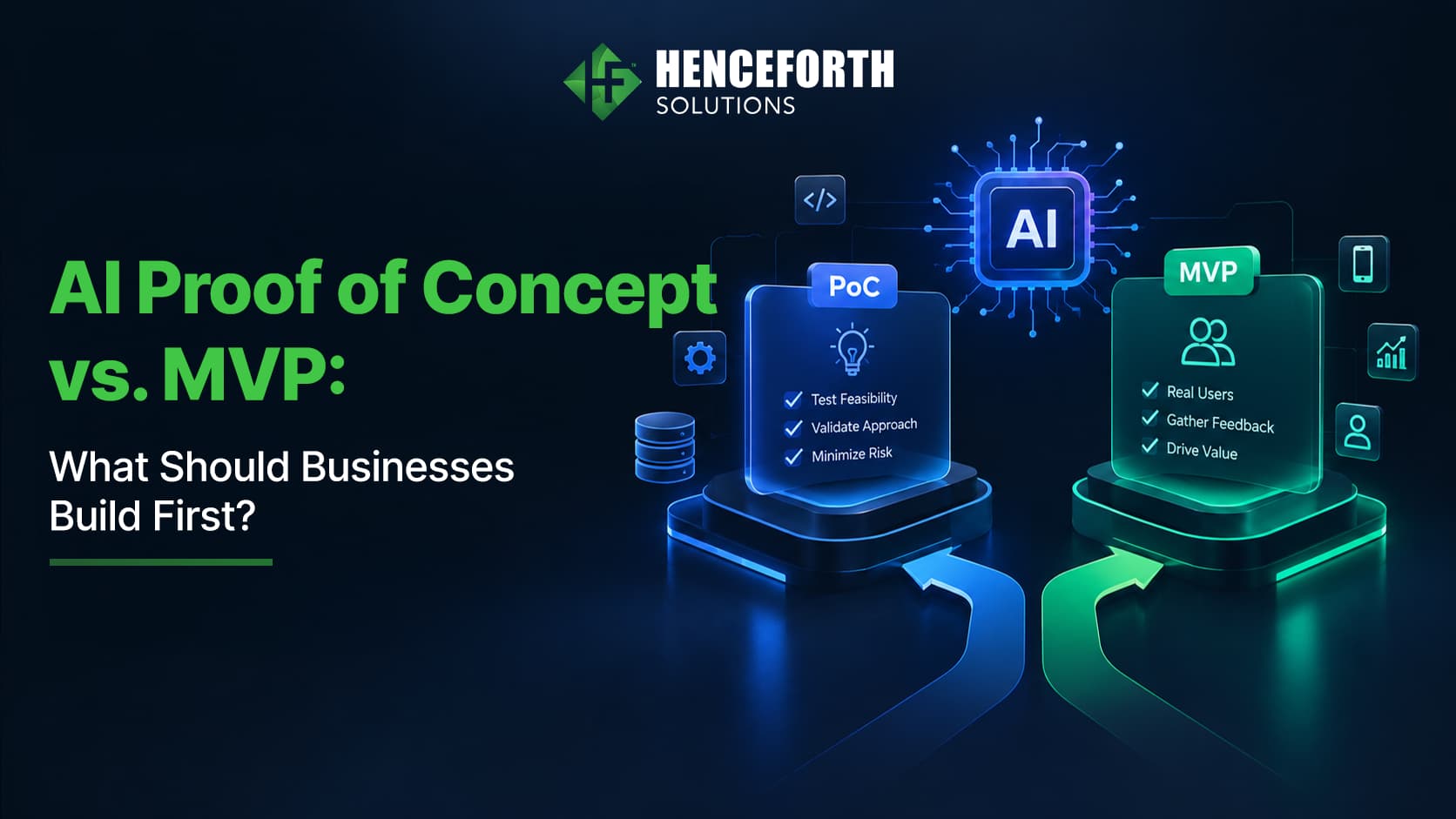
Artificial intelligence has moved from an interesting experiment to a practical business capability. Yet many organizations still get stuck at the same early question: should we begin with an AI proof of concept vs. MVP?
This guide explains the difference between an AI proof of concept (PoC) and an MVP, helping you choose the right starting point to validate technical feasibility.
What Is an AI Proof of Concept?
An AI proof of concept is a small-scale experiment aimed at answering one fundamental question: Is it technically possible to use the specific AI technique for the specific application?
The technical feasibility does not require any complicated interface, system integration, or production-level security. For instance, a logistics company can run a test of an AI model against their support email history to find out if the model can classify delays, damage, payment issues, and other queries.
When it comes to AI projects, a proof of concept is about testing the model/data/prompt/algorithms against a specific success criterion.
A typical AI PoC may include:
A narrow dataset, often sampled from real business data
A basic model, API, or prototype workflow
Manual testing by a small internal team
Simple evaluation measures, such as accuracy, response quality, error rate, or processing time
A clear go/no-go decision at the end
The output of a PoC is evidence, not a finished product. A successful PoC shows that the core technical assumption is strong enough to justify further investment.
What Is an AI MVP?
An AI MVP, or minimum viable product, is an early but usable version of a product that delivers enough core value for real users to begin using it. Unlike a PoC, an MVP is built for actual use. It may still be simple, but it should have a functional user experience, basic workflows, and a way to collect feedback. The goal is not merely to prove that AI works.
It is to learn whether people will use it, benefit from it, and potentially adopt it as part of their routine. For example, rather than simply testing whether AI can classify support emails, an AI MVP could be a simple internal dashboard for support agents.
The dashboard may have automatically classified tickets where agents can correct them if there is an error, as well as the amount of time saved by the tool. The MVP for an AI product generally has the following features:
A specific target audience
One key process that solves a crucial problem
A simple but usable interface
All data connections required for that process to work
Minimum access control, logging, and monitoring capabilities
A way to get feedback from users
An MVP is not just the smallest product a team can create. It is the smallest version of a product that provides valuable insights from actual users.
AI Proof of Concept vs. MVP: The Core Difference
The main difference in the AI proof of concept vs. MVP discussion is the question each one answers.
Factor | AI Proof of Concept | AI MVP |
|
|
|
A proof of concept answers a feasibility question. An MVP answers a value and adoption question.
Why Businesses Confuse the Two
Many AI projects fail not because the technology does not work, but because teams treat a successful PoC as proof that a product will succeed. A model may perform well in a controlled test, yet still fail in production because users do not trust it, the workflow is inconvenient, the data changes over time, or the integration with existing systems is difficult.
The reverse can also happen. A team may invest in building a full MVP before confirming that the underlying AI capability is reliable enough. If the model cannot meet basic quality requirements, the product may need a fundamental redesign.
That is why the sequence matters.
When Should You Build an AI Proof of Concept First?
A PoC is usually the better first step when the business is dealing with significant technical uncertainty. Consider starting with an AI proof of concept if:
You are unsure whether AI can perform the task accurately enough
The use case depends on specialized or messy business data
You need to compare multiple models, vendors, or approaches
The task involves high risk, such as legal, financial, medical, or safety-related decisions
You need internal approval or budget before building a product
You want to estimate costs, latency, infrastructure needs, or implementation complexity
The AI capability is new to your organization
A proof of concept will come in handy when the price of validating the hypothesis is low, but its value is high. Instead of wasting months on developing a product based on an unvalidated hypothesis, companies can discover quickly whether the underlying technology is technically possible.
When Should You Design an AI MVP First?
The MVP would be the way to go in cases where the technology aspect of the solution is clear while the question is whether the real users would find the solution valuable. You should consider building an AI MVP if:
You already know that the AI model or API can perform the task
Similar AI capabilities have been proven in your industry
The use case is relatively straightforward, such as summarization, drafting, classification, or search
You have access to the data needed to support the workflow
Users have a clear problem that the AI can address
You want feedback from real employees or customers quickly
The product needs to connect to existing tools or systems
The MVP can then reveal whether employees trust the answers, use the tool regularly, and find it faster than searching documents manually.
Do Not Ignore AI Governance
Whether a business begins with a PoC or an MVP, AI risk management should not be an afterthought. NIST’s AI Risk Management Framework organizes AI risk work around four functions: Govern, Map, Measure, and Manage. It emphasizes that risk management should be continuous and applied throughout the AI system lifecycle.
For an early AI project, this does not mean building enterprise-grade controls on day one. It means being intentional about:
What data is available to the AI
Who can use the AI system?
How is the output evaluated?
How errors, bias, privacy, and security issues are detected
Who is responsible for the decision-making and the monitoring process
A PoC must have some limits. An MVP must be more secure, as real users and business data are used.
Common Mistakes to Avoid
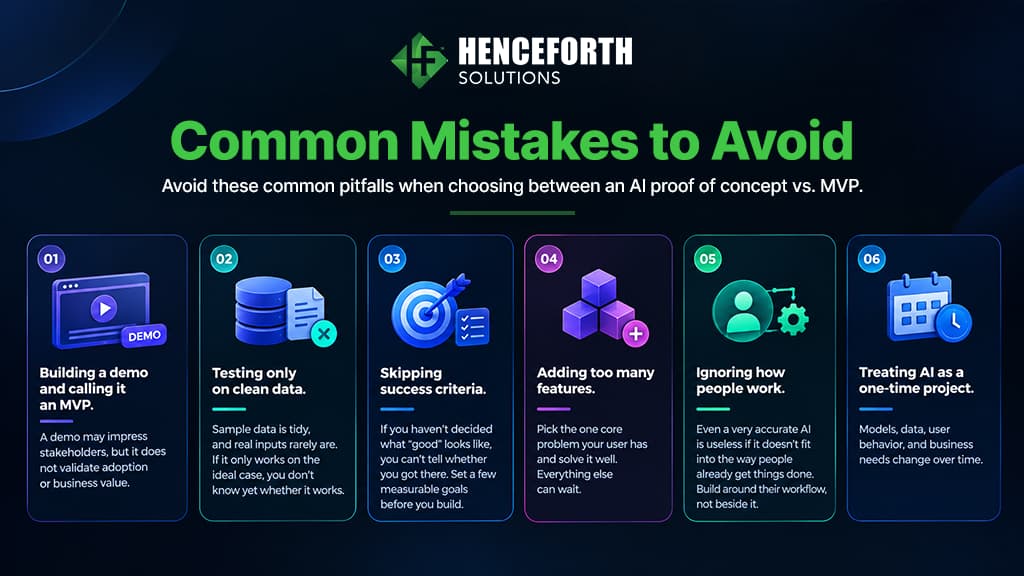
Businesses often make avoidable mistakes when choosing between an AI proof of concept vs. MVP, such as:
Building a demo and calling it an MVP. A demo may impress stakeholders, but it does not validate adoption or business value.
Testing only on clean data. Sample data is tidy, and real inputs rarely are. If it only works on the ideal case, you don’t know yet whether it works.
Skipping success criteria. If you haven’t decided what “good” looks like, you can’t tell whether you got there. Set a few measurable goals before you build.
Adding too many features. Pick the one core problem your user has and solve it well. Everything else can wait.
Ignoring how people work. Even a very accurate AI is useless if it doesn’t fit into the way people already get things done. Build around their workflow, not beside it.
Treating AI as a one-time project. Models, data, user behavior, and business needs change over time.
Final Thoughts
The choice between an AI proof of concept vs. MVP should depend on the type of risk the business needs to reduce first. Build an AI proof of concept when you need to know whether the technology can work. Build an AI MVP when you need to know whether people will use it and whether it creates measurable value.
For many organizations, the smartest approach is sequential: run a focused PoC to validate the core AI assumption, then build a small MVP to test real adoption and business impact. This approach limits wasted investment, produces better evidence, and gives the business a clearer path from experimentation to a production-ready AI solution.