Artificial intelligence is changing how businesses operate, serve customers, and make decisions. From intelligent chatbots and predictive analytics to generative AI applications and autonomous AI agents, businesses are increasingly adopting AI to solve operational challenges and create better digital experiences.
However, implementing AI successfully requires more than integrating an existing AI tool into a website or application. Businesses need solutions that understand their workflows, work with their existing systems, protect sensitive information, and deliver measurable results.
This is where an AI software development company makes a difference.
An experienced AI development partner helps businesses identify the right opportunities, select suitable technologies, develop custom AI applications, and integrate intelligent capabilities into their operations.
Whether you are a startup planning an AI-powered product or an established enterprise looking to automate complex processes, choosing the right development partner can determine the success of your AI initiative.
In this guide, we explore AI software development services, their business applications, development processes, benefits, and the important factors to consider when selecting an AI development company.
What Is an AI Software Development Company?
An AI software development company specializes in designing, developing, and implementing software applications powered by artificial intelligence and machine learning technologies.
Unlike traditional software development companies that primarily build applications around predefined instructions and business logic, AI development companies incorporate intelligent systems that can analyze information, recognize patterns, generate content, make predictions, and support decision-making.
These companies combine software engineering, data science, machine learning, and modern AI technologies to create solutions tailored to specific business requirements.
For example, an AI software development company can build:
Intelligent customer support chatbots that understand customer queries.
AI-powered business assistants that retrieve information from internal documents.
Predictive analytics applications that forecast business trends.
Recommendation engines that personalize customer experiences.
AI agents that automate repetitive business workflows.
Computer vision applications that analyze images and videos.
Generative AI applications that create and summarize content.
The primary objective is not simply to introduce artificial intelligence into an organization. It is to develop practical software that solves business problems, improves efficiency, and creates measurable value.
What Services Does an AI Software Development Company Offer?
AI development involves multiple technologies and capabilities. The services a business needs depend on its objectives, existing infrastructure, available data, and desired outcomes.
Here are some of the most important AI software development services businesses can consider.
1. Custom AI Software Development
Custom AI software development involves creating intelligent applications specifically designed around an organization's requirements.
Instead of relying entirely on generic software, businesses can develop applications that integrate their processes, data sources, and operational requirements into one intelligent system.
Examples include:
AI-powered enterprise management platforms.
Intelligent document processing systems.
Automated business intelligence applications.
AI-powered healthcare applications.
Custom recommendation engines.
Industry-specific AI software products.
Custom development is particularly useful when existing tools cannot accommodate specialized workflows or business requirements.
Explore Henceforth's AI development services to learn how custom AI solutions can support business transformation.
2. Generative AI Development
Generative AI enables software applications to create new content, summarize information, answer questions, and interact with users using natural language.
Modern generative AI applications commonly use large language models (LLMs), retrieval-augmented generation (RAG), and model integration techniques.
An AI software development company can build:
Custom AI assistants.
Enterprise knowledge management platforms.
AI content generation applications.
Intelligent document summarization tools.
AI-powered search applications.
LLM-powered business applications.
Custom GPT-based solutions.
For example, an enterprise can implement a knowledge assistant that retrieves relevant information from company documents and helps employees find answers without manually searching through multiple files.
The key is to develop a solution that connects AI capabilities with relevant business information while maintaining appropriate access controls and data protection.
Learn more about generative AI development services.
3. AI Agent Development
AI agents are intelligent software systems designed to understand tasks, use available tools, and perform actions toward defined objectives.
Unlike conventional chatbots that primarily respond to user messages, AI agents can interact with external applications, retrieve information, execute approved actions, and coordinate multi-step workflows.
Businesses can use AI agents for:
Customer support automation.
Sales lead qualification.
Appointment scheduling.
Internal knowledge retrieval.
Business process automation.
Data analysis and reporting.
CRM and ERP workflow management.
For example, an AI sales agent can qualify incoming leads, collect relevant information, update CRM records, and assist sales representatives with follow-up activities.
A well-designed AI agent should also include appropriate permissions, human approval mechanisms, activity monitoring, and error-handling procedures.
Explore AI agent and chatbot development services to understand how intelligent agents can support business operations.
4. Machine Learning Development
Machine learning enables software applications to identify patterns in data and use those patterns to make predictions or recommendations.
Instead of relying exclusively on manually defined rules, machine learning models learn from historical and continuously updated information.
Common machine learning applications include:
Predictive analytics.
Customer behavior analysis.
Fraud detection.
Demand forecasting.
Recommendation systems.
Customer churn prediction.
Predictive maintenance.
For example, an eCommerce business can use machine learning to analyze customer purchasing patterns and recommend products based on individual preferences.
Similarly, manufacturing companies can use predictive models to identify equipment performance patterns and anticipate potential maintenance requirements.
5. AI Chatbot and Conversational AI Development
AI chatbots help businesses interact with customers and employees through natural language conversations.
Modern conversational AI solutions can understand user intent, retrieve relevant information, maintain conversational context, and connect with existing business applications.
Common applications include:
Customer support assistants.
Website chatbots.
Healthcare virtual assistants.
Internal employee support systems.
eCommerce shopping assistants.
Appointment booking assistants.
For example, a customer support chatbot can answer frequently asked questions, provide order updates, guide users through troubleshooting, and transfer complex queries to human representatives.
The result is a more accessible support experience and reduced pressure on customer service teams.
6. AI Automation and Integration
AI automation combines artificial intelligence with existing software systems to reduce repetitive manual work.
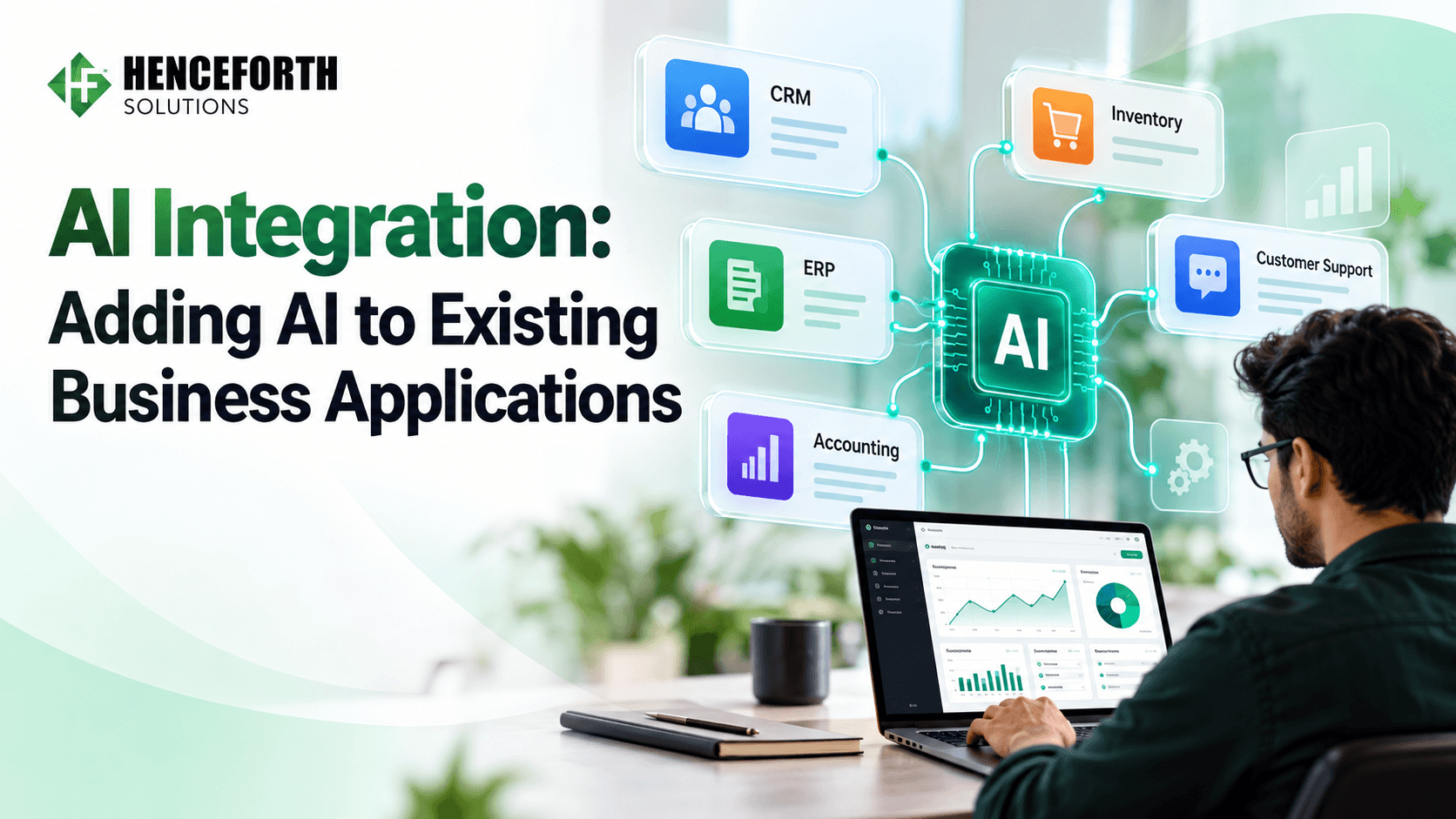
Businesses often operate across multiple applications, including CRM platforms, ERP systems, accounting software, communication tools, and internal databases.
An AI development partner can connect these systems and introduce intelligent automation into existing workflows.
Examples include:
Automated document processing.
Invoice information extraction.
Intelligent email classification.
Automated data entry.
Workflow monitoring.
Predictive reporting.
CRM and ERP integrations.
The objective is to make existing business processes more efficient without unnecessarily replacing the software infrastructure organizations already depend on.
Discover AI automation solutions by Henceforth.
7. Natural Language Processing and Computer Vision
Natural Language Processing (NLP) enables applications to understand, interpret, and process human language.
Computer vision allows software to analyze and extract information from images and videos.
Both technologies have applications across industries.
NLP applications:
Sentiment analysis.
Language translation.
Document classification.
Text summarization.
Voice-enabled assistants.
Intelligent information extraction.
Computer vision applications:
Image recognition.
Object detection.
Automated quality inspection.
Optical character recognition (OCR).
Visual product search.
Video analytics.
Combining these technologies can help businesses process large volumes of unstructured information and improve operational efficiency.
How Can Businesses Benefit from Custom AI Software Development?
Investing in AI software development can create value across different business functions. However, the benefits depend on choosing suitable use cases and implementing solutions that address genuine operational challenges.
Here are some of the major advantages.
Improved Operational Efficiency
AI-powered applications can automate repetitive activities such as document classification, information retrieval, data processing, and customer query handling.
This allows employees to focus on more strategic responsibilities while reducing unnecessary manual work.
Better Business Decision-Making
AI systems can analyze large datasets, recognize patterns, and generate insights that support informed business decisions.
Predictive analytics, for example, can help organizations understand demand patterns, evaluate business performance, and identify potential risks.
Enhanced Customer Experience
AI-powered chatbots, recommendation engines, and personalized assistants can help businesses deliver faster and more relevant customer interactions.
Customers can access information, receive recommendations, and resolve common queries without depending entirely on human support teams.
Reduced Operational Costs
Automating repetitive workflows can reduce the time and resources required to complete routine activities.
Businesses can also improve resource allocation by using predictive models and intelligent analytics.
Greater Business Scalability
Custom AI applications can be designed to support growing data volumes, increasing user activity, and changing operational requirements.
With suitable architecture and monitoring, businesses can expand their AI capabilities without rebuilding their entire software infrastructure.
Competitive Differentiation
Businesses that implement AI strategically can create more personalized products, improve internal processes, and introduce new digital services.
Custom AI software can also help organizations develop capabilities that differentiate their products from competitors using generic solutions.
Real-World Applications of AI Software Development Across Industries
Artificial intelligence is not limited to technology companies. Businesses across multiple industries are adopting AI to improve products, processes, and customer experiences.
Here are some practical examples.
Healthcare
Healthcare organizations can use AI to support administrative processes, medical documentation, patient communication, and information management.
Examples include:
AI-powered clinical documentation.
Medical image analysis.
Patient support chatbots.
Healthcare workflow automation.
Intelligent medical information retrieval.
FinTech and Banking
Financial organizations can implement AI to improve transaction monitoring, risk assessment, customer support, and financial analysis.
Examples include:
Fraud detection systems.
Automated financial document processing.
AI-powered customer assistants.
Credit risk analysis.
Intelligent financial reporting.
Retail and eCommerce
AI can help online retailers understand customer behavior, improve product discovery, and optimize inventory planning.
Examples include:
Personalized product recommendations.
AI shopping assistants.
Customer behavior prediction.
Demand forecasting.
Automated customer support.
Manufacturing
Manufacturers can use AI to improve production monitoring, quality control, and equipment management.
Examples include:
Computer vision-based quality inspection.
Predictive maintenance.
Production analytics.
Defect detection.
Intelligent inventory management.
Logistics and Transportation
AI can help logistics companies improve planning, monitor operations, and make more informed decisions.
Examples include:
Demand prediction.
Route optimization.
Shipment monitoring.
Warehouse automation.
Delivery forecasting.
What Is the AI Software Development Process?
Developing successful AI software requires a structured approach that combines business understanding, technical planning, development, testing, and continuous improvement.
A reliable AI software development company typically follows these stages.
Step 1: Requirement Analysis and Discovery
The first step is understanding the business problem and defining what the proposed AI application should accomplish.
The development team evaluates:
Business objectives.
Existing workflows.
User requirements.
Available data sources.
Technical limitations.
Expected business outcomes.
This stage helps establish a clear development direction.
Step 2: AI Strategy and Technology Selection
Once the requirements are understood, the team identifies the most suitable technologies and architecture.
Depending on the project, this may involve:
Machine learning models.
Large language models.
Generative AI frameworks.
Retrieval-augmented generation.
Natural Language Processing.
Computer vision.
AI agent frameworks.
The goal is to select technology based on actual project requirements rather than adopting AI simply because it is trending.
Step 3: Data Preparation and Architecture Design
AI applications depend on the quality and relevance of their underlying data.
This stage involves evaluating data availability, preparing datasets, identifying integration requirements, and designing the overall system architecture.
For enterprise applications, the architecture should also consider data access permissions, privacy, security, and scalability.
Step 4: AI Model Development and Software Engineering
The development team builds the application, implements the required AI capabilities, and integrates relevant services and APIs.
Depending on the solution, this can involve model development, model customization, prompt engineering, RAG implementation, backend development, and frontend engineering.
Step 5: Testing and Validation
Before deployment, the application needs to be tested against realistic business scenarios.
Testing should cover:
Functional accuracy.
Model performance.
Response quality.
Security and privacy.
Integration reliability.
Performance under different workloads.
Error handling and edge cases.
For generative AI and agent-based applications, evaluation should also include hallucination testing, permission checks, and validation of actions performed by the system.
Step 6: Deployment and Integration
After validation, the application is deployed into the required environment.
This may include cloud infrastructure, private hosting, on-premises environments, or integration with existing business applications.
The objective is to make the AI solution accessible to its intended users without disrupting essential business operations.
Step 7: Monitoring and Continuous Improvement
AI software requires ongoing monitoring after deployment.
Model performance, response quality, data changes, system reliability, and operating costs should be evaluated regularly.
Continuous improvement helps ensure that the application remains useful, secure, and aligned with changing business requirements.
How to Choose the Right AI Software Development Company?
Selecting an AI development partner is an important decision because AI projects involve technical complexity, business data, and long-term maintenance requirements.
Before hiring an AI software development company, consider the following factors.
1. Evaluate Technical Expertise
Look for a development team with experience in relevant technologies such as machine learning, generative AI, NLP, computer vision, LLM integration, and AI agents.
The right expertise should match your actual project requirements.
2. Review Previous Projects and Case Studies
A company's portfolio can help you understand its development capabilities and experience with real-world applications.
Look for projects that demonstrate practical implementation, meaningful functionality, and the ability to solve business problems.
3. Understand Its Development Approach
A reliable development partner should follow a structured process covering discovery, architecture, development, testing, deployment, and maintenance.
Ask how the team handles changing requirements, technical challenges, and project milestones.
4. Check Integration Capabilities
Most AI applications need to work alongside existing software.
Evaluate whether the development team can integrate AI solutions with your CRM, ERP, databases, APIs, cloud infrastructure, and other business applications.
5. Prioritize Data Security and Privacy
AI applications may process confidential business information and customer data.
Discuss data ownership, access controls, encryption, hosting arrangements, retention policies, and relevant compliance requirements before starting development.
6. Consider Scalability and Long-Term Support
Your AI solution should be capable of evolving alongside your business.
Choose a partner that considers ongoing monitoring, model updates, maintenance, performance optimization, and future integrations.
7. Compare Value Rather Than Just Cost
The cheapest development proposal is not necessarily the most cost-effective.
Compare the proposed architecture, development scope, technical expertise, ownership terms, integration capabilities, and post-launch support.
A transparent development partner should explain what is included in the proposal and how the solution will deliver business value.
How Much Does AI Software Development Cost?
The cost of developing AI software depends on the complexity of the application, required functionality, data availability, integrations, infrastructure, and development timeline.
A simple AI-powered chatbot may require considerably less effort than a custom enterprise AI platform involving multiple data sources, advanced machine learning models, and complex workflow integrations.
The following factors generally influence development costs:
Project complexity: More sophisticated AI applications require additional engineering and testing.
Data requirements: Data collection, cleaning, preparation, and processing can affect project scope.
AI model selection: Using an existing model, customizing a model, or developing a new model involves different levels of effort.
System integrations: Connecting AI applications with existing software can increase development requirements.
Infrastructure: Cloud hosting, computing resources, storage, and model usage contribute to ongoing costs.
Maintenance: Monitoring, optimization, security updates, and model improvements require continued investment.
Rather than relying on generic price estimates, businesses should request a project-specific assessment based on their requirements and expected outcomes.
Why Choose Henceforth Solutions as Your AI Software Development Partner?
Choosing an AI software development company is about finding a technology partner that understands both artificial intelligence and the business problems it needs to solve.
At Henceforth Solutions, we focus on developing practical AI-powered software, intelligent applications, and custom digital solutions designed around business requirements.
Our approach combines AI engineering, software development, and business-focused problem-solving to help organizations move from ideas to working applications.
Here is what we bring to AI development projects.
Business-Focused AI Consulting
Every successful AI project begins with understanding the problem.
We help businesses evaluate AI opportunities, identify suitable use cases, select relevant technologies, and establish a development roadmap.
Custom AI Agents and Chatbots
We develop intelligent assistants and AI agents that can retrieve information, interact with users, and automate relevant business workflows.
Generative AI Applications
Our generative AI capabilities include LLM-powered applications, RAG solutions, intelligent assistants, and custom AI applications built around business information.
AI Automation and Machine Learning
We help businesses introduce intelligent automation, predictive analytics, and machine learning capabilities into existing workflows.
End-to-End Software Engineering
Beyond AI development, we offer web development, mobile app development, software engineering, and integration capabilities to support complete digital products.
Security and Scalability
We consider security, application architecture, integration requirements, and future scalability throughout the development process.
Whether you are building a new AI-powered product or upgrading an existing application with intelligent capabilities, our team can help you plan and develop a solution aligned with your objectives.
Explore our AI services and solutions or contact our team to discuss your project.
Final Thoughts
Artificial intelligence is becoming an important part of modern software development, but successful implementation requires more than choosing an AI model or integrating a chatbot.
Businesses need intelligent applications that solve real problems, integrate with existing systems, protect important information, and adapt to changing requirements.
Working with the right AI software development company can help turn these opportunities into practical digital solutions.
Whether you need a custom AI application, an enterprise knowledge assistant, an intelligent chatbot, or an AI-powered automation platform, the right development approach starts with understanding your business goals.