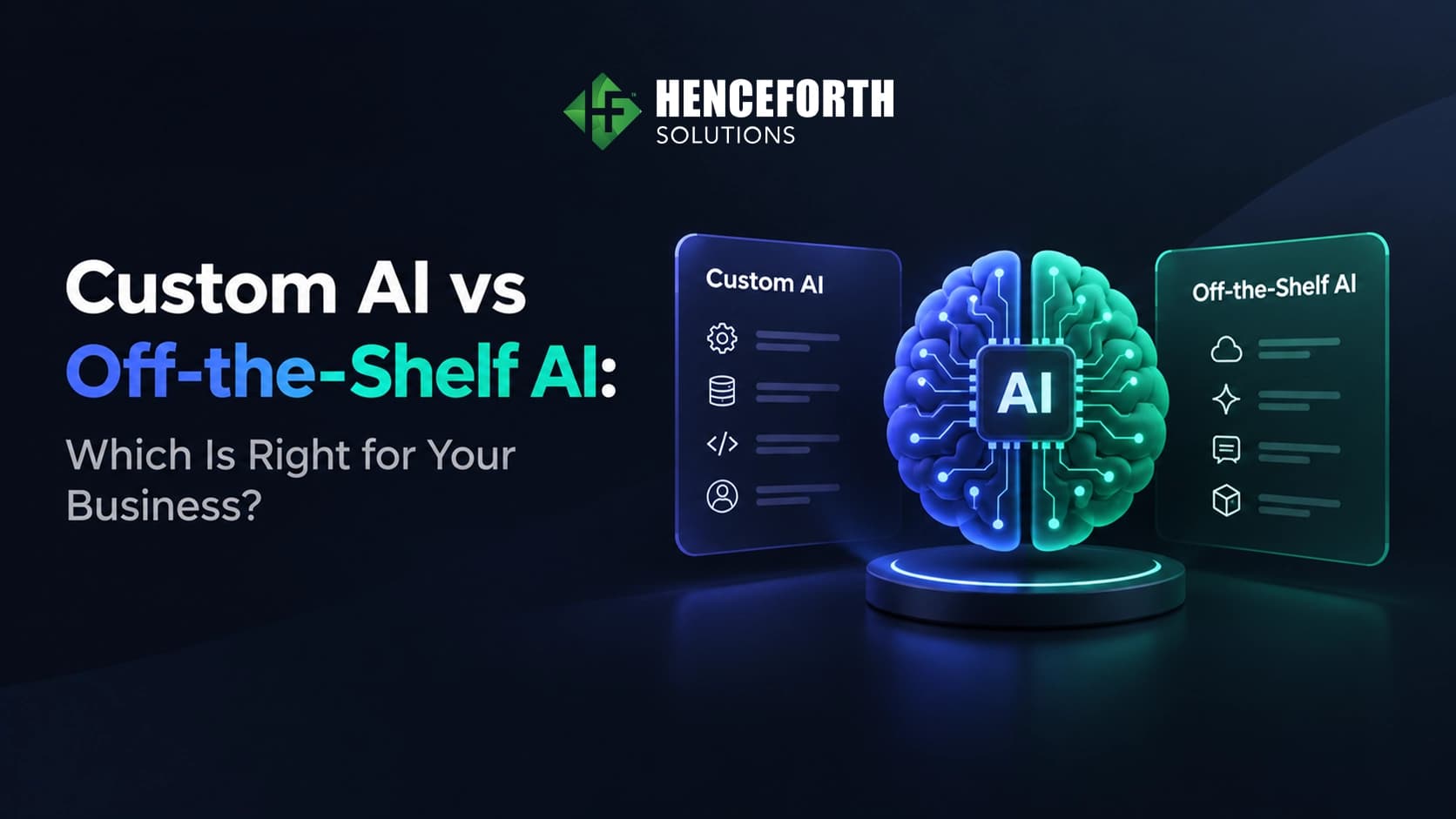
There are many more options for companies wishing to leverage AI than ever before. Some may find the option of starting with an existing AI solution more suitable, while others will need a tailor-made AI solution which works specifically for them. Having an understanding of custom AI vs off-the-shelf AI can allow businesses to determine which approach suits their real needs.
An off-the-shelf AI solution may offer out-of-the-box functionality while requiring much fewer efforts at the initial stage of development. On the contrary, custom AI is able to be built according to the specific processes and data.
What Is Custom AI?
Custom AI is an artificial intelligence solution built or configured to fit the needs of a business. The system may be built around the company’s workflows, data, users and software ecosystem, instead of depending on a one-size-fits-all offering.
A Custom AI development project can involve merging existing AI models, constructing standard models for machine learning, customizing models, implementing retrieval systems or designing AI-driven workflows.
Companies may turn to custom AI when they need:
AI capabilities that are designed for a certain process
Integration with proprietary enterprise systems
Specialized data or know-how
More control over how users feel
Custom automations
AI functionality for the industry
Capabilities not provided by existing products
Custom AI doesn’t necessarily entail constructing a base model from scratch. Businesses will often construct a custom application using current models and their own data.
What Is Off-the-Shelf AI?
Off-the-shelf AI is the ready-made AI solutions, platforms or services that a business can employ with minimal customisation.
These solutions are targeted for common use scenarios and may offer features such as:
Content generation and AI writing
Support
Document summarization.
Image generation
voice recognition
Data analysis
Generic purpose virtual help
Help with programming?
The major advantage is availability. In many cases, companies can use an existing AI solution without having to go through a full software development effort.
However, accessible functionality and the degree of customisation depends on the product and its configuration options.
Custom AI vs Off-the-Shelf AI: Key Differences
The main difference in custom AI vs off-the-shelf AI is the level of control and specialization available.
actor | Custom AI | Off-the-Shelf AI |
|---|---|---|
Customization | High | Usually limited to available options |
Development | Requires development and integration | Usually ready to use |
Business workflows | Can be designed around specific processes | Built around common use cases |
Data | Can use business-specific data | Depends on provider capabilities |
Integrations | Can be developed for required systems | Depends on supported integrations |
User experience | Can be fully tailored | Usually predefined |
Initial implementation | Generally more involved | Usually faster |
Control | Greater control over the solution | Dependent on provider |
Scalability | Architecture can be designed around requirements | Depends on provider and plan |
Maintenance | Business/development team manages the solution | Provider manages much of the product |
Neither approach is automatically suitable for every business. The decision should be based on what the software needs to accomplish.
When Is Custom AI a Better Fit?
A custom AI tool becomes more applicable in cases where regular tools cannot serve the needs of the business.
For instance, an organization could require an AI assistant who can handle proprietary documents, follow certain workflows, integrate with various systems in the business and offer different features to different users.
When custom AI Solution becomes useful is when:
Regular AI products cannot meet the workflow needs
There is need for proprietary data
There is need for connection of multiple systems in the organization
There is need for a customized experience for the business
There are certain industrial tasks that AI needs to do
There is need for specialized automation
There is need for control over the architecture
Customized AI development can also enable organizations to integrate AI within their software applications without having to work with external AI tools.
Custom AI vs Off-the-Shelf AI for Business Data
And data is a big factor in the custom AI vs off-the-shelf AI decision.
With off-the-shelf products, the ability to connect to proprietary information may be limited, based on the source and the product. Custom AI applications can be built on specialized sources of enterprise data, databases, documents, and APIs.
A corporation might create an internal AI knowledge base that pulls information from approved company documents and databases, for example. The application can then place access permissions and business-specific workflows around that AI capabilities.
But the use of proprietary data also brings with it extra obligations for data quality, access, privacy, security and governance. Businesses developing generative AI applications can also consult the OWASP GenAI Security Project for guidance on common AI application security risks.
Custom AI vs Off-the-Shelf AI for Integrations
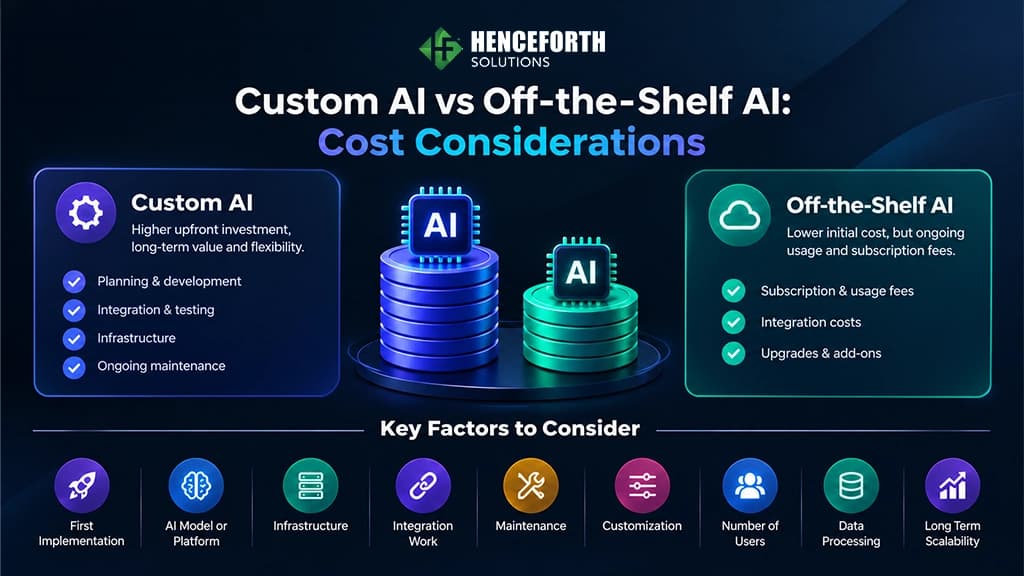
The custom AI vs off-the-shelf AI comparison also has various cost structures.
Off-the-shelf AI typically decreases initial development needs as the product is already in existence. But organizations can incur recurrent subscription, usage, integration and upgrade charges.
Custom AI generally involves a larger initial investment in planning, development, integration, testing and deployment. It may also require continuing engineering and infrastructure support.
The correct comparison should thus reflect overall ownership requirements and not merely the initial price.
A business should consider:
First Implementation
AI model or platform use
Infrastructure
Integration work
Maintenance
Customization
Number of users
Data Processing.
long term scalability
Integration requirements can be a big part of the decision.
Off-the-shelf solutions might already have connectors with major corporate apps. If the necessary systems are supported, it can reduce the implementation effort.
For greater flexibility, a custom solution is the way to go when a firm has to combine AI with proprietary apps, legacy systems, internal databases or customized workflows.
For companies with complicated software ecosystems, the question isn’t just whether an AI model works. The bigger issue is how well the artificial intelligence can be integrated into existing business applications that staff and customers already use.
Custom AI vs Off-the-Shelf AI: Cost Considerations
Can Businesses Combine Custom and Off-the-Shelf AI?
Yes. Not every AI needs a company to adopt a single approach.
A hybrid approach can be a mix of existing AI models or services and new application development. For example, a corporation might take advantage of an existing huge language model but build their own UI, business logic, retrieval system, rights, workflows, and integrations.
This method can open access to proven AI capabilities, while allowing the organization to tailor the most critical elements to its operations.
That same company may deploy off-the-shelf AI to boost employee productivity and develop unique AI for a customer-facing product.
How to Choose Between Custom AI and Off-the-Shelf AI
Rather than making decisions on the speed of development or on a liking for a technology, firms should assess their real needs before jumping in.
Ask these questions:
Is the AI use case common or very specialized?
What degree of customization does the business need?
Does the application rely on proprietary data?
What systems does the AI need to interface with?
How much control do you want for the user over the experience?
What security and data needs are there?
How many users and transactions are you expecting?
Does the AI solution need to grow over time?
What continuing technical assistance is available?
What business results do you expect?
Off-the-shelf artificial intelligence can be a realistic starting point if a pre-existing solution satisfies the requirements. If you want more flexibility, exclusive workflows or sophisticated integrations for your organization, then custom AI development may be worth looking into.
Conclusion
The choice between custom AI vs off-the-shelf AI does not depend on technology per se, but on the nature of the problem that the business wants to solve.
An off-the-shelf approach can help in situations when standardization is required and speed and convenience matter. The custom approach can offer more flexibility in cases where the business requires customized workflows, proprietary data, integration or other features.
For many businesses, however, the optimal solution would probably consist of using both approaches.