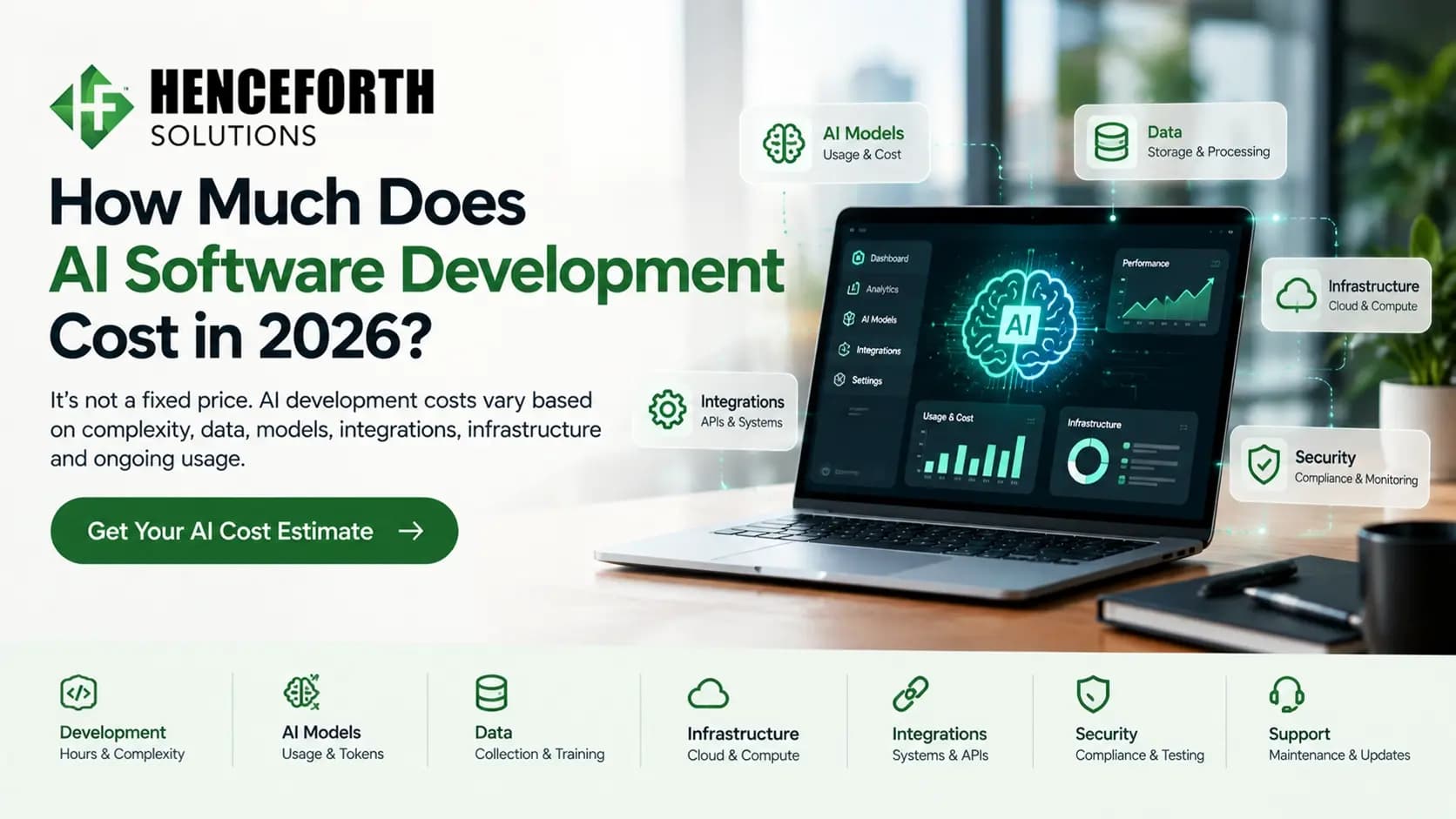
It is impossible to predict the AI software development cost in 2026 because it will vary based on the complexity of the product, amount of data required, number of models used, and how tightly it should be integrated into existing processes. A standard AI component will be a whole other matter compared to a complex enterprise product that will involve integrations, AI agents, and proprietary models.
There will not be a one-price-fits-all for every project involving AI technologies. It is better to split the expenditure on development, AI models usage, data costs, infrastructure, integrations, security measures, testing, and support. AWS suggests estimating the costs prior to the production by taking into consideration query volume, token consumption, model cost, cloud infrastructure, and additional components such as vector databases.
AI Software Development Cost in 2026
For planning purposes, businesses can think about AI projects in three broad levels:
AI software type | Typical project scope | Relative cost |
Basic AI feature | Existing AI API, chatbot, recommendation, content generation | Low |
Custom AI application | AI workflows, custom backend, databases, multiple integrations | Medium |
Enterprise AI platform | Advanced models, large datasets, complex integrations, security and monitoring | High |
These categories are useful for initial planning, but they should not be treated as fixed market prices. The actual cost to develop AI software depends on the technical architecture, development hours, model usage, data requirements, and business goals.
What Affects AI Software Development Cost?
Several factors can change the final AI development cost significantly.
1. Type of AI Solution
The first driver of cost is the kind of AI solution that is being created. An AI chatbot using an already existing large language model will have other requirements compared to machine learning platforms that require data pipelines and predictive models.
Examples of projects can include:
AI chatbot creation
Generative AI software
Machine learning platforms
Recommendation engines
Predictive analytics
Computer vision
AI agents creation
Intelligent automation
The more specific an AI capability is, the more technical expertise it may need.
2. AI Model and API Costs
While using an already existing AI model can help save time by avoiding creation and training of the model, it will incur costs for using it.
For the case of generative AI applications, the cost will be dependent on factors like:
Number of requests
Number of tokens in inputs/outputs
The chosen model
Length of response
Number of users
Frequency of AI use
Context and requirement for retrieval
According to AWS, it is advisable to create a production cost model that estimates query volumes, token usage, model cost, and infrastructure cost, not just the initial development cost.
3. Data Preparation and Training
Data could play a significant role in the custom AI development cost if there is a need for proprietary data or customized machine learning model.
There could be costs associated with collection, cleansing, labeling, transformation, storage, and security of data. If there is a need for model training or tuning, there could be extra computing and engineering effort needed.
For some cases, building on top of an existing foundation model could be a better solution than building a model from scratch.
4. Features and Application Complexity
AI is just one part of the product. The end product may also need functionalities such as user management, dashboards, searching, notifications, payment processing, administration, reporting, or role-based access.
For instance, an AI-powered knowledge base for internal use will need to be able to perform tasks such as uploading documents, authentication, searching, retrieval, permissions, and administration dashboard among others.
5. Integrations
AI programs may have to integrate with legacy systems of the company. Integration with CRM, ERP, payment processing, communication, analytics, or any other internal systems could influence the total AI software development cost.
Such factors that impact the complexity include the number of systems to integrate with, available API, authentication methods, data synchronization, and frequency of data transfer between systems.
6. Cloud and Infrastructure
AI software needs to have an infrastructure for the hosting of applications, databases, model access, data processing, monitoring, and GPU computations.
In the case of generative AI applications, there can be infrastructure costs related to vector databases, retrieval systems, guardrails, and other supporting systems. According to AWS, cost and performance emerge as key architectural concerns for building a production-grade AI application.
Selecting the right-sized model and implementing techniques such as caching can control recurring costs.
AI Software Development Cost by Development Approach
Another way to estimate the cost to develop AI software is to look at the development approach.
In this case, the business connects its application with an existing model of AI via API or platform. It is relevant when a business requires certain capabilities such as text generation, summarization, classification, or conversation assist without creating a foundation model.
While the upfront cost of development will be lower, the ongoing usage cost and cost of infrastructure have to be considered when calculating the total cost of ownership.
Specialized businesses can adapt or customize the existing models by themselves using their data and processes. The process can include additional costs such as data processing, engineering, testing, and evaluation.
Creating a customized model may involve much more resources. According to different cases, businesses may require big amounts of data, data scientists, machine learning engineers, computing resources, model evaluation, and monitoring.
The choice of strategy should be based on the necessity of a custom model. More technology does not necessarily mean more business value.
Hidden Costs in AI Software Development
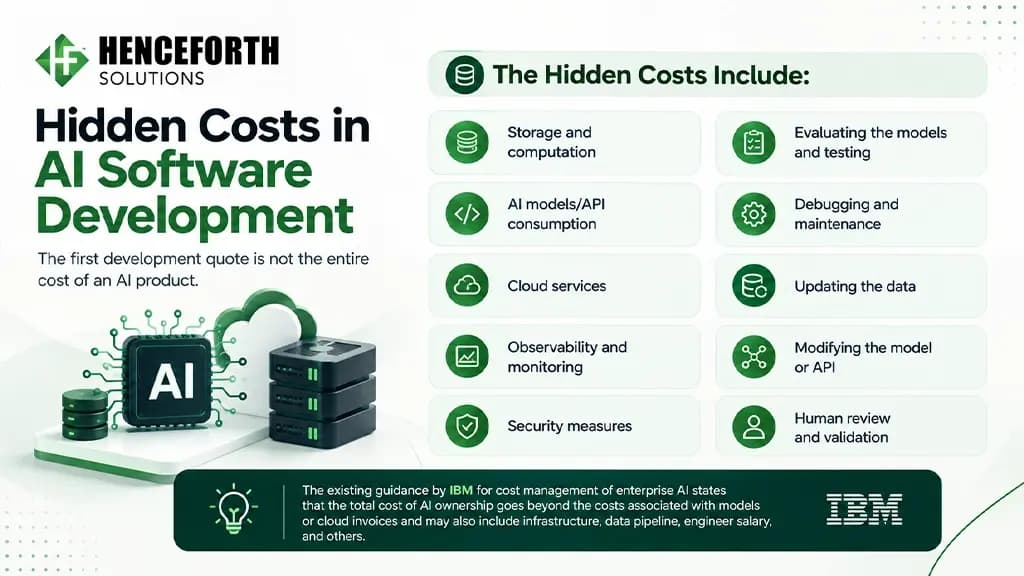
The first development quote is not the entire cost of an AI product.
The firm must also take into consideration:
Storage and computation
AI models/API consumption
Cloud services
Observability and monitoring
Security measures
Evaluating the models and testing
Debugging and maintenance
Updating the data
Modifying the model or API
Human review and validation
The existing guidance by IBM for cost management of enterprise AI states that the total cost of AI ownership goes beyond the costs associated with models or cloud invoices and may also include infrastructure, data pipeline, engineer salary, and others.
How to Reduce AI Software Development Cost
The lowering of the AI development cost does not mean adopting low-cost technologies but means building the system based on its real needs.
A company can reduce the cost of developing a solution by:
Focusing on a specific use case from the beginning
Leveraging existing AI models where applicable
Selecting a model depending on the level of difficulty of the task
Omitting non-critical features in the first version of the system
Taking advantage of existing business data and systems when possible
Tracking the usage of models and infrastructure
Leveraging caching for frequent requests
Cost testing the solution prior to going live
Defining business metrics prior to scaling
In particular, AWS suggests selecting the model based on its real needs and doing the cost modeling before putting the solution into production.
How to Estimate Your AI Software Development Cost
The initial assessment must begin by considering the business requirements instead of a pricing list.
Take into account these considerations:
What issue does the AI application address?
Who will use the software?
What kind of AI capability is needed?
Is an existing or custom-built model going to be used?
What kinds of business data does the system require?
With what applications is integration required?
How many users and how many AI requests are anticipated?
What are the security and compliance requirements?
What kind of infrastructure is needed?
How much maintenance and AI usage cost is there?
According to AWS, businesses should have a baseline, taking into account both visible and invisible costs when assessing their AI investment. It will give them an opportunity to compare the cost of implementing with expected benefits of operating.
Is AI Software Development Worth the Investment?
The answer depends on the business case, not simply on the technology.
A useful evaluation should compare the expected investment with measurable outcomes such as reduced processing time, lower operational costs, improved customer service, increased conversion, faster decision-making, or additional revenue.
Google Cloud's DORA research also emphasizes that faster AI-assisted development does not automatically translate into financial impact. Businesses need to connect technical improvements with measurable business outcomes.
Conclusion
The AI software development cost in 2026 depends on the solution's complexity, AI model requirements, data, integrations, infrastructure, security, and ongoing usage. A focused application using existing AI capabilities can have very different requirements from a large custom AI platform.
Instead of asking only how much AI software costs to build, businesses should evaluate the complete investment across development and operation. A clear use case, suitable technology, realistic cost model, and measurable business goals can help create an AI solution that is technically practical and financially sustainable.