“My app needs to feel more….hip or trendy” Four years ago, that statement would’ve gotten you blank stares from developers and an invoice for thousands in consulting fees. Today? An AI understands exactly what you mean and generates the code while you grab coffee. Welcome to the era of vibe coding – today your half-formed thoughts and aesthetic preferences transform into functional software faster than you can say “tech revolution.”
This isn’t your parents’ programming. Gone are the days of memorizing arcane syntax and debugging until 3 AM. Instead, we’re entering a world where the barrier between what you envision and what your computer creates is evaporating, replaced by AI that translates vibes into algorithms. It’s like having a mind-reading developer bestie who never sleeps, never complains, and works for pocket change.
But as Gen Z developers flock to these tools and tech veterans sound alarms, we’re all left wondering: Is this intuitive, AI-assisted approach to programming the ultimate glow-up for tech, or are we coding ourselves into digital chaos? Let’s spill the tea on the most transformative shift in programming since the internet.
How We Got Here?
The evolution of programming has been a journey of increasing abstraction and accessibility. We started with punch cards and machine code that required specialized knowledge. After that, gradually we shifted to development of higher-level languages. Now, we’re witnessing the rise of AI coding assistants that bridge the remaining gap between human thought and machine execution.
This progression hasn’t happened overnight. Each step removed barriers and broadened participation. But the current leap that we have taken to AI assistance represents something fundamentally different. Tools like GitHub Copilot, Amazon CodeWhisperer, and ChatGPT’s coding capabilities aren’t just new languages or frameworks – they’re collaborators that understand context and intent.
What’s particularly striking is how quickly younger developers have embraced these tools. Gen Z programmers have grown up in a world where AI recommendations are commonplace. They are adopting these assistants at rates that have established tech companies reconsidering their development workflows. Recent surveys suggest that over 60% of developers under 25 regularly use AI coding tools, compared to just 35% of developers over 40.
The Vibe Coding Multiverse
The ecosystem of vibe coding tools is diverse and rapidly expanding. Each platform offers unique approaches to the AI-human collaboration:
Replit
Having transformed into more than just an online IDE, Replit is now a collaborative environment where teams can code together in real-time with AI assistance. Its integrated AI features help explain code and suggest improvements. It even generates entire functions based on comments..
Bolt
This platform takes a minimalist approach that masks complexity behind an intuitive interface. What sets it apart is how it handles natural language instructions. It also translates them into functional code while maintaining a clean, distraction-free workspace. Bolt’s strength lies in rapid prototyping, allowing developers to translate concepts into working demos with unprecedented speed.
Cursor
Cursor’s strength is that it reimagines the traditional IDE by deeply integrating AI capabilities. Beyond just suggesting code, it helps developers understand complex codebases. Along with it refactors existing solutions, and explains how different components interact. Its contextual awareness means it can guide you through unfamiliar code almost like an experienced pair programmer.
GitHub Copilot
The pioneer that established vibe coding as a legitimate approach was GitHub Copilot. Its deep integration with development environments and vast training on public repositories means it often feels like it’s reading your mind. It program exactly suggests what you need before you’ve fully formulated the thought yourself.
AI Model Face-Off: Who’s Actually Slaying?
Not all AI coding assistants are the same. Their capabilities, limitations, and best use cases vary significantly:
OpenAI GPT-4
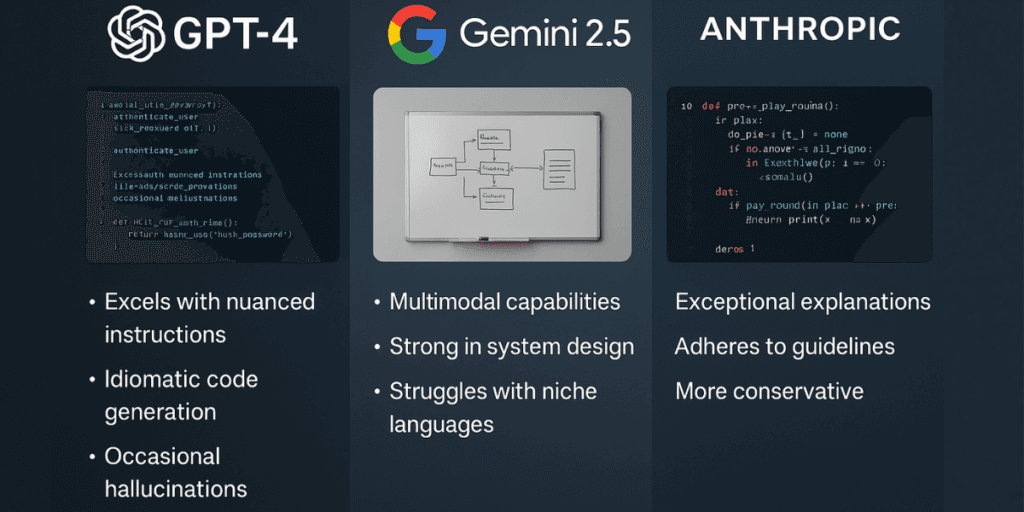
GPT excels at understanding context and nuance in instructions. This is its key quality that is making it particularly effective when requirements are complex or ambiguous. It generates idiomatic code that fits naturally within the existing codebases. THe generated code also adapts to your personal coding style over time. However, it occasionally hallucinated features or libraries that don’t exist, which can lead to frustrating debugging sessions. It’s also among the more expensive options for regular use.
For example.A developer team used GPT-4 to refactor an entire authentication system by describing security requirements and edge cases in plain English. This reduced what would have been weeks of work into days.
Google Gemini 2.5
Google’s gen AI stands out for its multimodal capabilities . It can analyze screenshots, diagrams, and even handwritten notes to understand system requirements. This makes it exceptionally valuable for translating design concepts into working prototypes. Its strength in system design helps developers think through architecture before writing a single line of code. However, it sometimes struggles with niche programming languages and specialized frameworks.
In practice, several startups have used Gemini to transform whiteboard designs directly into functional prototypes.
Anthropic Claude Sonnet
Claude distinguishes itself through exceptional explanation capabilities and adherence to specified guidelines. Its longer context window allows it to understand large codebases more comprehensively. Though the tool is sometimes more conservative in its suggestions, it often results in more reliable, production-ready code.
Educational platforms have leveraged Claude to create interactive coding lessons. These lessons not only provide solutions but explain the underlying principles, helping students build genuine understanding rather than dependency
Successes and Failures
In this section, we talk about the stories or instances where Vibe-coding has shone bright and a few where it has not. There also are some experiences of people that were neither complete fails nor absolutes successes, we also are mentioning them.
The Glow-Up Stories
my saas was built with Cursor, zero hand written code
AI is no longer just an assistant, it’s also the builder
Now, you can continue to whine about it or start building.
P.S. Yes, people pay for it— leo (@leojr94_) March 15, 2025
I uploaded a playable demo of my vibe-coded game for the #vibejam.https://t.co/lWOCF5Useo
22 days. 17,658 lines of code.
Coded by @AnthropicAI Claude, @grok, and @GeminiApp. Runs on @threejs. Character designs by @Grok, @reveimage, @GeminiApp. Models by Trellis and… pic.twitter.com/11IdPSrdqC— Luke Van In 🎗️ (@lukevanin) March 31, 2025
The Flop Era Moments
I failed badly at AI (Vibe)coding with @cursor_ai …..
Tried fixing some bugs for my saas and ended up making changes to the point where i couldn't recover the production database.
Here is what i learnt the hard way:
– Keep production data separate.
– Don’t try build a… pic.twitter.com/25neGvnoUx— Deepak Mehta (@mehtasdeepak) March 20, 2025
If your going to share the good stories from vibe coding you have to share the bad.
Tried to add another parameter to an edge function. Cursor and 3.7 absolutely shredded it. Tons of improvements but now the function fails so it thrashed around changing CORS headers and adding…— Josh Dance (@JoshDance) March 20, 2025
The Moments in-between
vibe coding is pretty wild. it created a fully functional mini-website for me, then got confused about how to integrate a plugin, messed up the package management so bad that it stopped working, then I had it migrate itself into an entirely new project to fix it.
— kuzushi (@kuzushi) April 2, 2025
I'm so excited for what I (finally) built with vibe coding.
It won't look like much to many of you.
It is huge for me.
It took four tries 💪 but I nailed it.
Check it out https://t.co/r7Ae7r8y8B.
👇Check out the fails along the way:
1. A website to prescribe presbyopia
2.…— Alexandra Zubko (@aczubko) March 31, 2025
The success stories emerging from vibe coding adoption are impressive and diverse:
The Skills Discourse™
The rise of vibe coding has ignited passionate debate about the future of programming skills:
Advocates argue that these tools are democratizing software development. This is allowing people with domain expertise but limited coding experience to create functional software. They point to examples like marketers building their own analytics tools or healthcare professionals developing patient management systems without traditional CS backgrounds.
Critics counter that this democratization comes at a cost . They believe that a generation of developers is emerging who can prompt but don’t understand fundamentals. They worry about long-term maintenance along with security implications, and the ability to solve novel problems.
A fascinating experiment at a recent hackathon pitted traditional programmers against AI-assisted developers on identical projects. While the AI-assisted team delivered a functional prototype faster, the traditionally coded solution performed better under stress testing and proved easier to modify when requirements changed mid-competition.
It’s All About Creating a Fine Balance
The most successful implementations of vibe coding come from finding the right balance:
Effective developers understand when AI assistance is valuable (rapid prototyping, generating boilerplate, exploring unfamiliar APIs) and when traditional approaches are superior (performance-critical code, security implementations, novel algorithms).
Companies like Vercel are demonstrating how to integrate AI into development workflows while maintaining code quality. Their approach involves using AI for initial implementation and exploration. Later implementing human review and refinement before production deployment.
The key seems to be understanding enough fundamentals to evaluate and improve AI-generated code rather than accepting it blindly. This hybrid approach combines the speed advantages of AI with the reliability advantages of human oversight.
The Future Is Looking Extra
Industry experts anticipate several trends as vibe coding continues to evolve:
AI tools will become increasingly personalized, learning individual developers’ styles, preferences, and common patterns. This personalization will make collaboration more natural and effective over time.
Educational institutions are already adapting curricula to focus more on conceptual understanding along with system design. They are focusing on effective collaboration with AI tools rather than syntax memorization or implementation details.
The most significant shift may be the normalization of AI-human pair programming as the standard development approach. With AI handling implementation details while humans focus remains on architecture, requirements, and quality control, many processes are simplified
The Final Tea
Vibe coding represents a significant inflection point in software development. It offers both tremendous opportunities and substantial risks. The tools are undeniably powerful for learning and prototyping while accelerating development. Though we need to understand that launching production applications based solely on AI-generated code remains risky.
While these tools have democratized coding in unprecedented ways, they work best when complemented by fundamental understanding. For beginners, AI assistants offer an incredible entry point to programming concepts without the traditional syntax barriers. For experienced developers, they eliminate repetitive tasks and allow focus on more challenging aspects of software design.
The most prudent approach combines the intuitive interface of vibe coding with the security of expert oversight. For serious projects, having skilled programmers review AI-generated code for vulnerabilities and performance issues remains essential.
The Resource Plug
For those looking to explore vibe coding responsibly:
Beginner-friendly AI coding tools: Replit, GitHub Copilot
Communities for AI coding: r/Programming,
Learning fundamentals: CS50 by Harvard
Prompt engineering guides: Learn Prompting
The question isn’t whether vibe coding will transform software development – it already has. The real question is how we harness these tools to create better, more accessible software while mitigating the risks they introduce.